Backpropagation From Scratch: Chain Rule, Computation Graphs, and Topological Sort
How microgpt.py's 15-line backward() works. From high school calculus to chain rule, computation graphs, topological sort, and backpropagation.
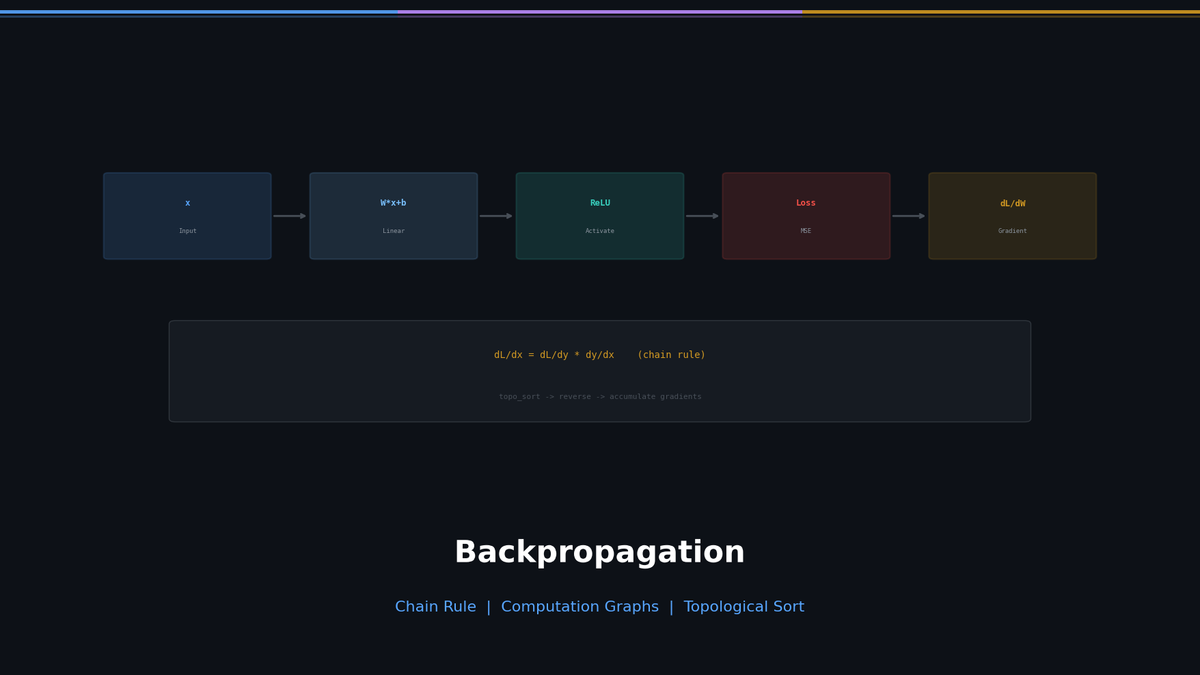
Backpropagation From Scratch: Chain Rule, Computation Graphs, and Topological Sort
The backward() function in microgpt.py is 15 lines long. But these 15 lines are a complete implementation of the core algorithm that underpins all of deep learning -- backpropagation.
This post connects "why do we need topological sort?" and "what is the chain rule?" starting from high school calculus all the way to the backward() function in microgpt.py.
The Central Question of Deep Learning
Training a neural network means this:
- Feed an input and compute the output (forward pass)
- Measure how far the output is from the correct answer (loss)
- Compute how much each parameter contributed to the loss (gradient)
- Adjust each parameter slightly in the direction that reduces the loss (update)
Step 3 is the hard part. Whether there are 4,192 parameters (microgpt.py) or 70 billion (LLaMA), you need to compute "if I nudge this parameter slightly, how much does the loss change?" for each one.
Related Posts
Paper of the Week #3 — Half the FLOPs Is Not Half the Time
One integer halves a fine-grained MoE's expert compute (arXiv 2609.04575) and its Table 5 replicates on one A100 to within a point. The paper never reports time, so I measured it: nothing in HF transformers, nothing at batch 1 in the vLLM you run today, 1.35x at batch 8. Plus the OLMoE control and the iso-cost harness control promised in issue #2.
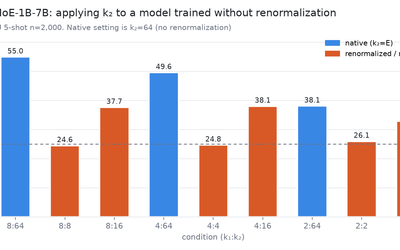
The paper stopped at half the experts. A quarter loses four points instead of thirty, and a model trained without renormalization tells you why.
Two cells arXiv:2609.04575 never ran: k₁=2 and k₁=3 on Qwen3.6-35B-A3B, and the whole k₂ trick on OLMoE, which was trained without renormalization. The second one is a clean test of the paper's mechanism.
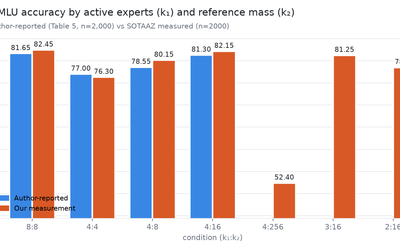
One integer halves MoE expert compute. We measured the speed the paper didn't: free at batch 8, not at batch 1.
We reproduced Table 5 of arXiv:2609.04575 on one A100 and measured the throughput the paper leaves out: nothing in HF transformers, nothing at batch 1 in stock vLLM, 1.35× at batch 8.