LLM Inference Optimization Part 4 — Production Serving
Production deployment with vLLM and TGI. Continuous Batching, Speculative Decoding, memory budget design, and throughput benchmarks.
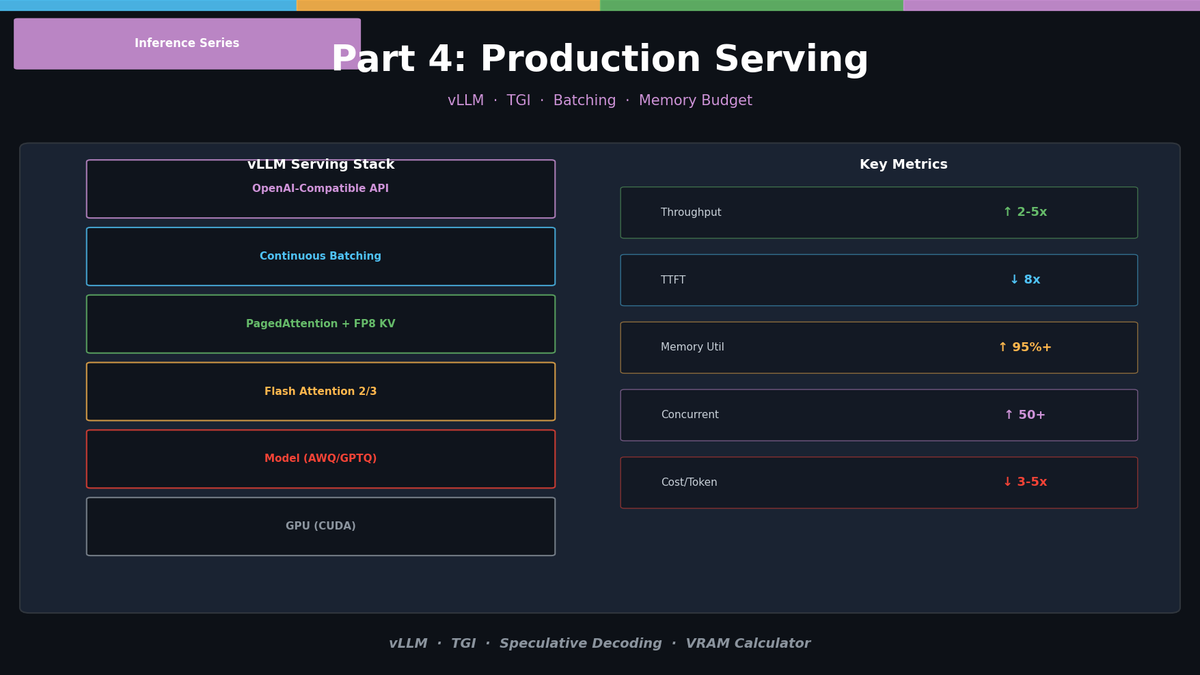
LLM Inference Optimization Part 4 — Production Serving
This is the final part of the series. Here we cover how to combine the Attention optimizations, KV Cache management, and Sparse Attention techniques from Parts 1–3 in a real production environment.
The key tools are vLLM and TGI (Text Generation Inference). We'll walk through how these two engines integrate the optimizations we've learned, and how to configure them in practice — with code.
vLLM vs TGI — At a Glance
| Feature | vLLM | TGI (HuggingFace) |
|---|---|---|
| PagedAttention | Built-in | Built-in |
| Continuous Batching | Supported | Supported |
| Flash Attention | Supported | Supported |
| KV Cache Quantization | FP8 supported | Partial support |
| Model Quantization | AWQ, GPTQ, Marlin | AWQ, GPTQ, EETQ |
| Speculative Decoding | Supported | Supported |
| Multi-GPU (Tensor Parallel) | Supported | Supported |
| API Compatibility | OpenAI-compatible | Custom + OpenAI-compatible |
| Installation | pip install | Docker-based |
Related Posts
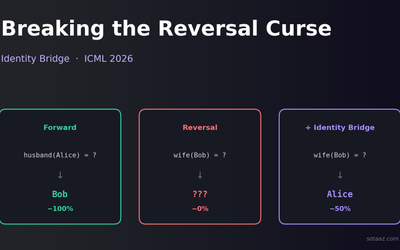
Breaking the Reversal Curse with Identity Bridges — the ICML 2026 fix that shouldn't work but does
LLMs trained on "Alice's husband is Bob" famously fail on "Bob's wife is?" — the reversal curse. A new ICML 2026 paper fixes it by adding one weird kind of self-referential example to the training set. The naive version doesn't work; the right version does.
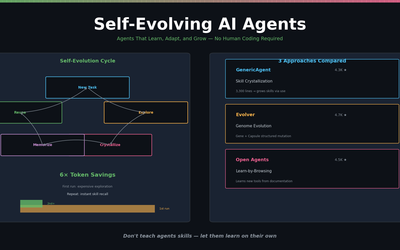
Self-Evolving AI Agents — The New Paradigm of 2026
GenericAgent, Evolver, Open Agents — comparing 3 self-evolving agent frameworks that learn, adapt, and grow without human coding.
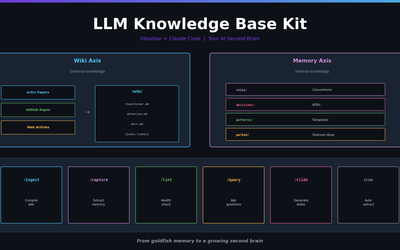
Build Your Own LLM Knowledge Base — A Karpathy-Style Knowledge System
Complete guide to building a permanent personal knowledge system with Obsidian + Claude Code. Wiki + Memory dual-axis architecture.