SANA: O(n²)→O(n) Linear Attention Generates 1024² Images in 0.6 Seconds
How Linear Attention solved Self-Attention quadratic complexity. The secret behind 100x faster generation compared to DiT.
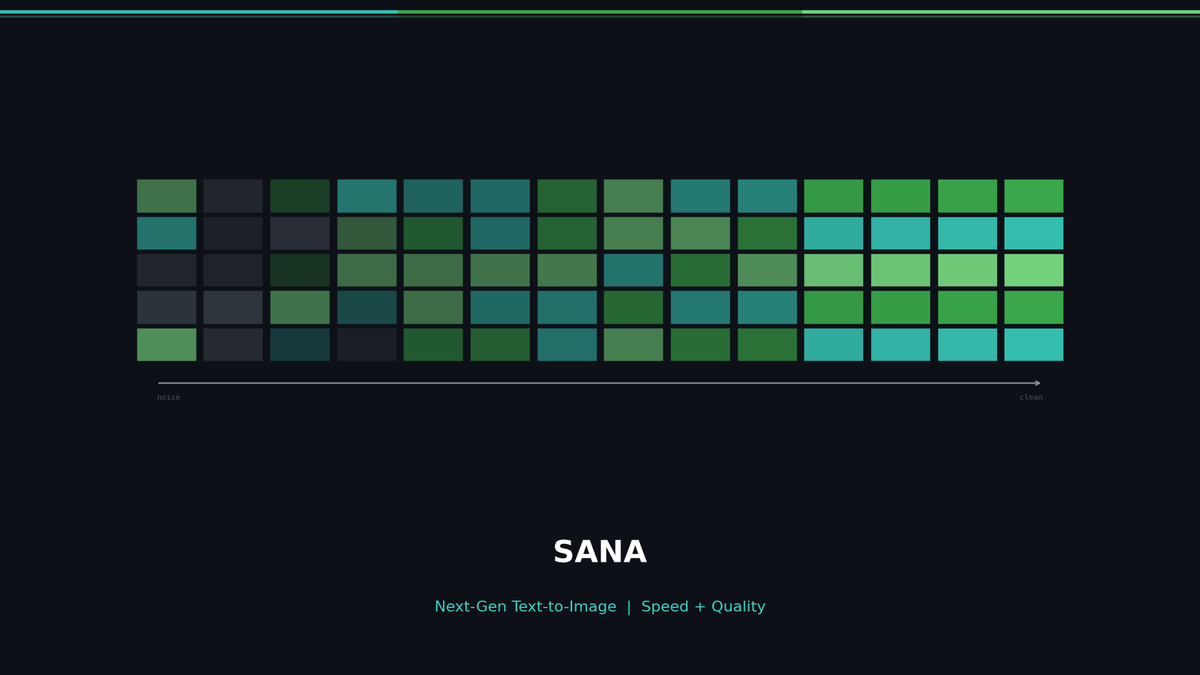
SANA: Ultra-Fast High-Resolution Image Generation with Linear Attention
TL;DR: SANA generates 1024×1024 images in just 0.6 seconds through Linear Attention and efficient token compression. It's a groundbreaking architecture that's 100x faster than DiT while maintaining equivalent quality.
1. Introduction: Overcoming the Speed-Quality Tradeoff
1.1 Speed Issues with Existing Diffusion Models
High-resolution image generation is computationally expensive:
Related Posts
TurboQuant in vLLM on One A100 — Capacity, Speed, and Accuracy of All Four Presets on an 8B Model
vLLM 0.28, Qwen3-8B bf16, one A100 80GB: KV capacity, batched throughput, 32K decode, needle-in-haystack, and GSM8K for bf16, fp8, and all four TurboQuant presets — the 8B size vLLM's own study skipped.
TurboQuant From Scratch on Real KV Tensors — What 3 Bits Actually Cost, and Why the Forks Beat the Paper's Layout
PolarQuant in 60 lines of PyTorch on real KV from Llama-3.2-1B and Qwen3-8B: 3-bit costs +10% perplexity, k8v4 +0.2%, QJL only pays below 4 bits, and the block-32 layout explains half the forks' edge.
TurboQuant llama.cpp CUDA Fork, Measured on an A100 — turbo4 Matches q4_0, turbo3 Breaks at Long Context
Qwen3-8B Q4_K_M on one A100, six KV types: perplexity, prefill, decode-at-depth, and VRAM measured. turbo4 matches q4_0 quality and beats q8_0 decode 2.5x at depth; turbo3 triples perplexity at 32K context.