LLM Reasoning Failures Part 1: Structural Limitations -- Scaling Won't Fix These
Reversal Curse, Counting, Compositional Reasoning — fundamental Transformer failures tested across 7 models.
LLM Reasoning Failures Part 1: Structural Limitations -- Scaling Won't Fix These
This is the first installment in our series dissecting LLM reasoning failures. In this post, we cover three fundamental limitations that persist no matter how much you scale the model or expand the training data.
- The Reversal Curse
- Counting Failures
- The Compositional Reasoning Wall
These failures stem from the Transformer architecture itself. Prompt engineering and scaling cannot fundamentally resolve them. Drawing from the survey by Song, Han, and Goodman (2025), we present hands-on experiments across 7 models alongside the theoretical analysis.
1. The Reversal Curse
What the Paper Says
If a model has learned "A is B," can it infer "B is A"? Song et al. (2025) call this failure the *Reversal Curse*. The Transformer's next-token prediction objective (unidirectional training) strengthens weights only in the "A to B" direction. "B to A" cannot be inferred unless it was separately learned.
Critically, this problem resists scaling due to Zipf's law. The sentence "Tom Cruise's mother is Mary Lee Pfeiffer" may appear in training data, but "Mary Lee Pfeiffer's son is Tom Cruise" is far rarer. When a celebrity's name is the subject, data is abundant; when an obscure person's name is the subject, data is scarce. This distributional asymmetry is structural.
Related Posts

Paper of the Week #3 — Half the FLOPs Is Not Half the Time
One integer halves a fine-grained MoE's expert compute (arXiv 2609.04575) and its Table 5 replicates on one A100 to within a point. The paper never reports time, so I measured it: nothing in HF transformers, nothing at batch 1 in the vLLM you run today, 1.35x at batch 8. Plus the OLMoE control and the iso-cost harness control promised in issue #2.
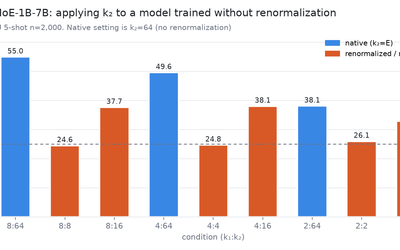
The paper stopped at half the experts. A quarter loses four points instead of thirty, and a model trained without renormalization tells you why.
Two cells arXiv:2609.04575 never ran: k₁=2 and k₁=3 on Qwen3.6-35B-A3B, and the whole k₂ trick on OLMoE, which was trained without renormalization. The second one is a clean test of the paper's mechanism.
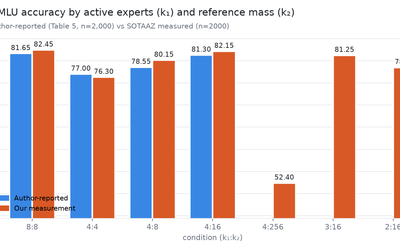
One integer halves MoE expert compute. We measured the speed the paper didn't: free at batch 8, not at batch 1.
We reproduced Table 5 of arXiv:2609.04575 on one A100 and measured the throughput the paper leaves out: nothing in HF transformers, nothing at batch 1 in stock vLLM, 1.35× at batch 8.