Gemma 4 — Google's Open Model That Rewrites the Rules
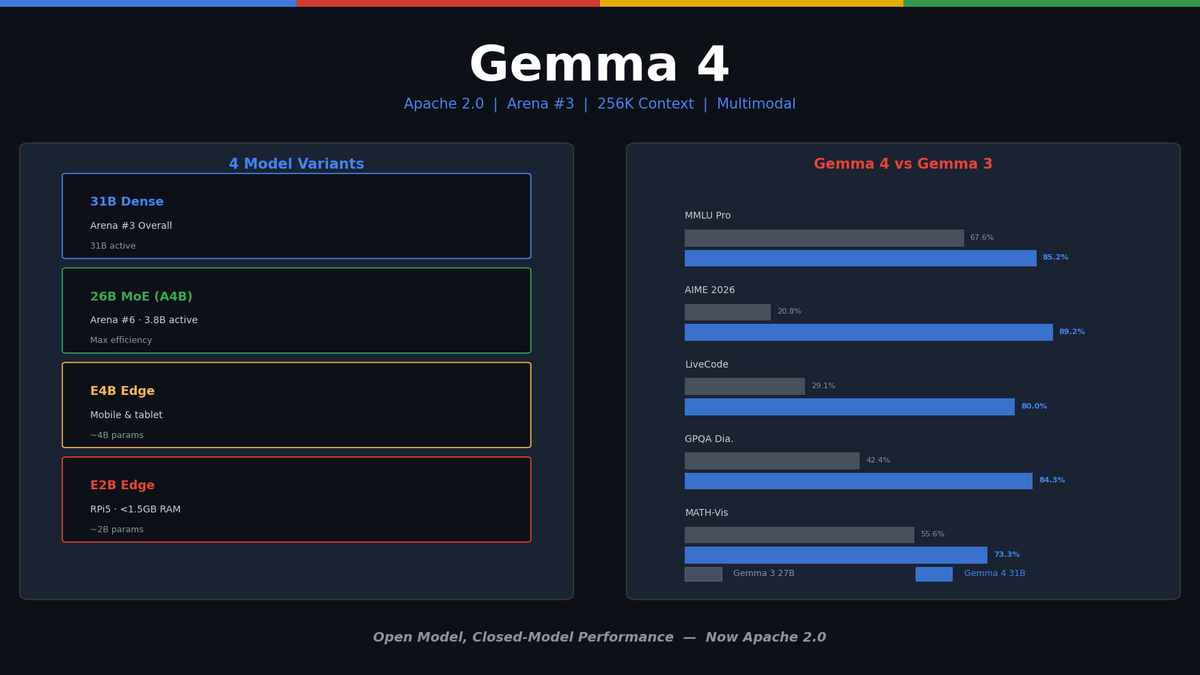
First Gemma model under Apache 2.0. Arena #3 overall. 31B Dense, 26B MoE (3.8B active), E4B/E2B edge models. AIME 89.2%, Codeforces ELO 2150, 256K context, multimodal.
Gemma 4: Google's Open Model That Rewrites the Rules
On April 2, 2026, Google released Gemma 4 — the first Gemma model under the Apache 2.0 license — and it immediately landed at #3 on the Chatbot Arena leaderboard, setting a new standard for open models.
A 31B parameter model competing with GPT-4o and Claude 3.5 Sonnet. A 3.8B active-parameter MoE model running on a single consumer GPU. Edge models that fit in under 1.5GB of RAM. Four model variants, 256K context, multimodal (text + image + audio). Let's break it all down.
The Gemma 4 Lineup
| Model | Parameters | Active Params | Arena Rank | Use Case |
|---|---|---|---|---|
| Gemma 4 31B | 31B (Dense) | 31B | #3 Overall | Peak performance, server/cloud |
| Gemma 4 26B (A4B) | 26B (MoE) | 3.8B | #6 Overall | Maximum efficiency, local GPU |
| Gemma 4 E4B | ~4B | ~4B | — | Mobile/edge |
| Gemma 4 E2B | ~2B | ~2B | — | Ultra-light edge, IoT |
Key Points
- Apache 2.0: First for the Gemma series. Full commercial use, modification, and redistribution. A major shift from Gemma 3's restrictive license.
- MoE Architecture: The 26B model activates only 3.8B of its 26B parameters during inference. Memory and compute costs drop dramatically.
- 256K Context: All models support 256K tokens. Analyze entire codebases and long documents.
- Multimodal: Text, image, and audio input. Native aspect-ratio handling for images.
Benchmarks: How Much Better Than Gemma 3?
Gemma 4 31B vs Gemma 3 27B:
| Benchmark | Gemma 3 27B | Gemma 4 31B | Change |
|---|---|---|---|
| MMLU Pro | 67.6% | 85.2% | +17.6p |
| AIME 2026 | 20.8% | 89.2% | +68.4p |
| LiveCodeBench v6 | 29.1% | 80.0% | +50.9p |
| Codeforces ELO | 1154 | 2150 | +996 |
| GPQA Diamond | 42.4% | 84.3% | +41.9p |
| MATH-Vision | 55.6% | 73.3% | +17.7p |
89.2% on AIME 2026 is staggering. Gemma 3 scored 20.8%. This isn't an incremental improvement — it's a generational leap in mathematical reasoning.
Codeforces ELO 2150 puts it at human Master level. Best-in-class among open models for competitive programming.
Architecture: What Changed
Dense Model (31B)
Standard Transformer architecture with several optimizations:
- Hybrid Attention: Sliding Window + Global Attention. Efficiently handles both local and long-range context.
- GQA (Grouped Query Attention): Groups Key-Value heads to reduce memory footprint.
- Per-layer Embeddings: Independent embeddings per layer for richer representations.
- QK/V Normalization: Normalizes queries, keys, and values for training stability.
- Proportional RoPE: Proportional positional encoding that maintains performance at long contexts.
- Softcapping: Bounds logit values to prevent extreme probability distributions.
MoE Model (26B/A4B)
Mixture-of-Experts with 26B total parameters, 3.8B active during inference:
- Expert layers placed independently between dense layers
- Router selects appropriate experts per input token
- Extreme parameter efficiency — Arena #6 with just 3.8B active parameters is unprecedented
Edge Models (E4B, E2B)
- E2B runs in under 1.5GB of memory
- Raspberry Pi 5: 133 tok/s prefill, 7.6 tok/s decode
- Designed for mobile, IoT, and embedded devices
Competitive Landscape
vs Qwen 3.5 (Alibaba)
| Gemma 4 31B | Qwen 3.5 32B | |
|---|---|---|
| License | Apache 2.0 | Apache 2.0 |
| Arena Rank | #3 | ~#8 |
| MMLU Pro | 85.2% | ~82% |
| Coding | Codeforces 2150 | ~1900 |
| Multimodal | Text+Image+Audio | Text+Image |
| Edge Models | E2B (1.5GB) | None |
Gemma 4 leads in benchmarks, edge lineup, and audio support.
vs Llama 4 (Meta)
| Gemma 4 31B | Llama 4 Scout | |
|---|---|---|
| License | Apache 2.0 | Llama License |
| Architecture | Dense | MoE (17B active/109B) |
| Arena Rank | #3 | #4 |
| Context | 256K | 10M |
| Edge Models | E2B/E4B | None |
Llama 4's 10M token context is impressive, but Gemma 4 wins on Arena ranking and licensing. Meta's Llama License requires separate licensing for 700M+ monthly users and prohibits using outputs to train competing models.
Ecosystem: Day-One Support
Major inference frameworks supported from launch:
- llama.cpp: GGUF quantized models available immediately
- Ollama:
ollama run gemma4— one command to run locally - vLLM: Production serving optimized
- LM Studio: Local GUI-based execution
- transformers.js: Run in the browser
- Google AI Studio: Free API access
Running Locally with Ollama
# 31B Dense model
ollama run gemma4:31b

# 26B MoE model (lightweight)
ollama run gemma4:26b

# Edge model
ollama run gemma4:e2b
Fine-Tuning: LoRA Customization
Gemma 4 supports 140+ languages out of the box, but domain or style-specific tasks benefit from fine-tuning.
Thanks to Gemma 4's Apache 2.0 license, commercial distribution of fine-tuned models is fully unrestricted — the biggest licensing change from previous Gemma versions.
MoE models require a different LoRA approach than Dense — which Expert layers to target, why the Router stays frozen, how to adjust learning rates. We've put together a full series covering theory through production code.
LoRA Fine-Tuning Series — From Theory to Gemma 4 MoE in Practice
Parts 1-3 cover LoRA theory, QLoRA, and evaluation/deployment. Part 4 applies LoRA to Gemma 4 MoE Expert layers. Includes hands-on notebooks.
Who Should Use What?
Gemma 4 31B (Dense):
- Production services demanding peak performance
- RAG pipelines, code generation, complex reasoning
- GPU server environments (A100/H100)
Gemma 4 26B/A4B (MoE):
- High performance on local GPUs
- Best model you can run on a single RTX 4090
- Maximum performance-per-dollar
Gemma 4 E4B/E2B (Edge):
- Mobile app integration
- IoT/embedded systems
- Offline-capable environments
Conclusion
Gemma 4 matters for three reasons:
- Apache 2.0: A new licensing standard for open models. Use, modify, and distribute commercially with zero restrictions.
- Performance: Arena #3 proves open models can compete head-to-head with closed ones.
- Edge lineup: Models running in under 1.5GB on a Raspberry Pi — the practical start of on-device AI.
The MoE model (26B/A4B) is particularly impressive. Arena #6 with only 3.8B active parameters sets a new benchmark for parameter efficiency. For developers wanting to run powerful LLMs locally, this is the most compelling option available today.
References
Related Posts
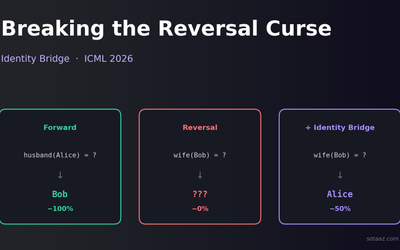
Breaking the Reversal Curse with Identity Bridges — the ICML 2026 fix that shouldn't work but does
LLMs trained on "Alice's husband is Bob" famously fail on "Bob's wife is?" — the reversal curse. A new ICML 2026 paper fixes it by adding one weird kind of self-referential example to the training set. The naive version doesn't work; the right version does.
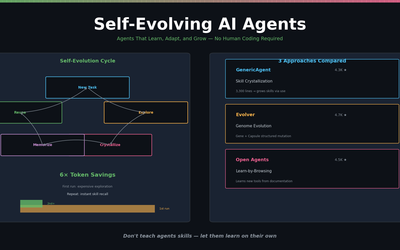
Self-Evolving AI Agents — The New Paradigm of 2026
GenericAgent, Evolver, Open Agents — comparing 3 self-evolving agent frameworks that learn, adapt, and grow without human coding.
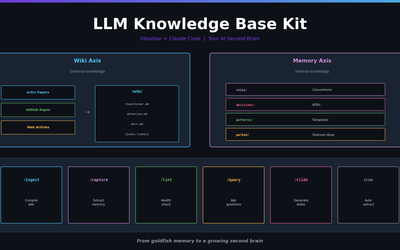
Build Your Own LLM Knowledge Base — A Karpathy-Style Knowledge System
Complete guide to building a permanent personal knowledge system with Obsidian + Claude Code. Wiki + Memory dual-axis architecture.