Flash Attention vs Sparse Attention — The Key to Faster LLM Inference
From principles to benchmarks: Flash Attention vs Sparse Attention. DSA, DMS, Sliding Window comparison with a decision matrix for choosing the right approach.
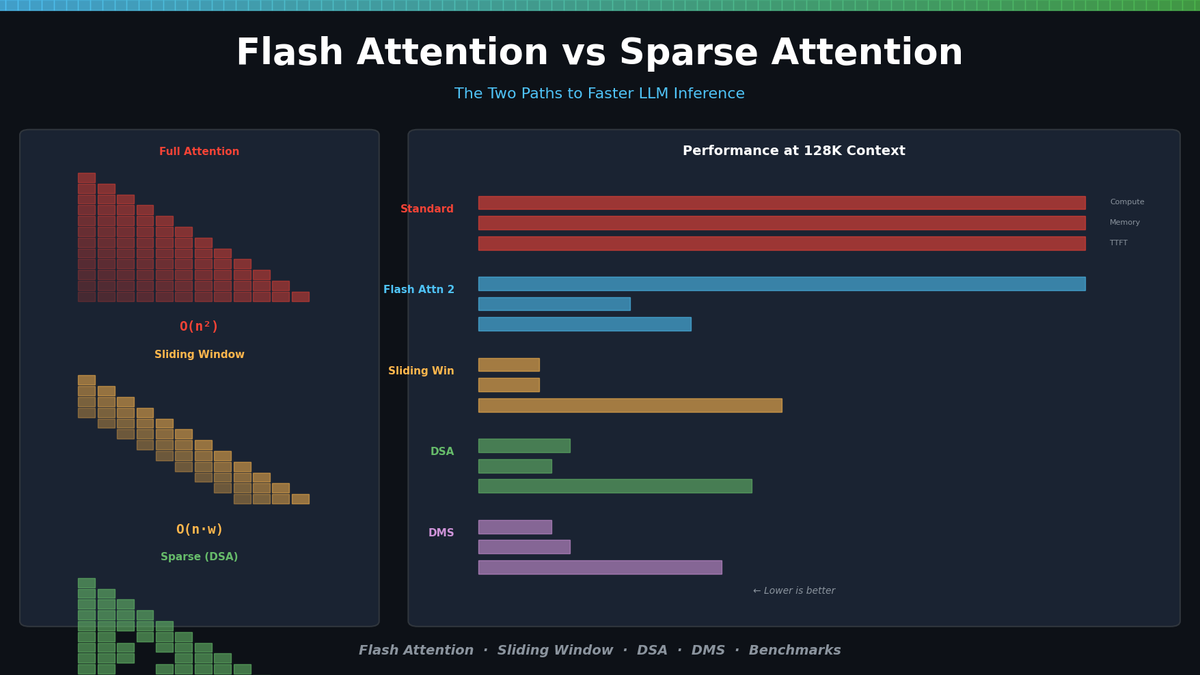
Flash Attention vs Sparse Attention — The Key Technologies Behind LLM Inference Speed
We live in an era where AI agents analyze entire code repositories and process conversation histories spanning hundreds of thousands of tokens. As context length grows, the $O(n^2)$ cost of the Attention operation becomes a critical bottleneck.
In this post, we compare two key technologies that tackle this bottleneck — Flash Attention and Sparse Attention — from their underlying principles to real-world benchmarks.
The Problem: Attention's $O(n^2)$ Wall
Standard Self-Attention computes the relationship between every pair of tokens. For a sequence of length $n$:
- Computation: $O(n^2 \cdot d)$ — scales quadratically with the number of tokens
- Memory: $O(n^2)$ — the entire Attention Score matrix must be held in memory
| Sequence Length | Attention Matrix Size | fp16 Memory |
|---|---|---|
| 2K | 4M | 8 MB |
| 8K | 64M | 128 MB |
| 32K | 1B | 2 GB |
| 128K | 16B | 32 GB |
At 128K context, the Attention Score matrix alone takes 32 GB. That's for a single head — factor in multi-head attention and the memory requirements become completely impractical.
Flash Attention: Hardware-Level Optimization
Flash Attention produces the exact same mathematical result while dramatically reducing memory usage. The core idea is to exploit the GPU's memory hierarchy.
How It Works: Tiling + Online Softmax
Standard Attention loads the full $n \times n$ Attention Score matrix into the GPU's HBM (High Bandwidth Memory). Flash Attention splits this matrix into small tiles and processes them in SRAM (high-speed on-chip memory).
[Standard Attention]
1. Q × Kᵀ → Store full Attention Score (n×n) in HBM
2. Softmax → Read from HBM and write back
3. Score × V → Read from HBM and write result
→ HBM accesses: 3 (slow)

[Flash Attention]
1. Load Q, K, V in tile-sized chunks into SRAM
2. Compute Score + Softmax + V multiplication in one pass per tile
3. Write only the final result to HBM
→ HBM accesses: 1 (fast)
The key point: the total computation does not decrease. It's still $O(n^2)$. But by reducing the number of memory accesses, actual wall-clock speed improves by 2–4x.
Flash Attention Version History
| Version | Year | Key Improvement | Speedup |
|---|---|---|---|
| Flash Attention 1 | 2022 | Tiling + Kernel Fusion | 2–4x over standard |
| Flash Attention 2 | 2023 | Better parallelism, asymmetric Q/KV split | ~2x over FA1 |
| Flash Attention 3 | 2024 | Hopper GPU optimization, FP8 support | ~1.5x over FA2 |
Using It in Code
from transformers import AutoModelForCausalLM

# Flash Attention 2 is natively integrated in transformers
model = AutoModelForCausalLM.from_pretrained(
    "meta-llama/Llama-3.1-8B-Instruct",
    torch_dtype=torch.float16,
    device_map="auto",
    attn_implementation="flash_attention_2",  # Just add this one line
)# Or use it directly
from flash_attn import flash_attn_func
# (batch, seq_len, num_heads, head_dim)
output = flash_attn_func(q, k, v, causal=True)Limitations of Flash Attention
- Computation stays the same: Still $O(n^2)$ — not a fundamental solution for 128K+ contexts
- GPU-dependent: Requires CUDA; optimal performance on Hopper/Ampere and above
- Memory savings are limited to Attention Scores: The KV Cache itself is not reduced
Sliding Window Attention: The Simplest Form of Sparse
If Flash Attention is about "doing the same computation faster," Sparse Attention is about "doing less computation altogether."
The simplest form is Sliding Window Attention, which only attends to tokens within a fixed-size window.
[Full Attention — attends to all tokens]
Token 8: [1][2][3][4][5][6][7][8] ← 8 tokens attended

[Sliding Window (W=4)]
Token 8: [_][_][_][_][5][6][7][8] ← Only 4 tokens attended- Advantage: Computation drops to $O(n \cdot w)$ ($w$ = window size)
- Critical drawback: Completely forgets early prompt content outside the window
Mistral 7B uses a Sliding Window of 4096 — if the initial system prompt falls beyond 4K tokens back, it becomes unreachable. In agentic workflows, this kind of "amnesia" is a dealbreaker.
Sparse Attention: Selectively Attending to What Matters
Sparse Attention solves the amnesia problem of Sliding Window. Instead of attending to all tokens or only recent ones, it dynamically selects only the most important tokens.
DeepSeek Sparse Attention (DSA)
This approach, introduced in DeepSeek-V3.2, operates as a two-stage pipeline:
Stage 1 — Lightning Indexer (Lightweight Scanner)
- Quickly scans the entire context and computes an "importance score" for each token
- Computation: ~10% of full Attention
- Output: an index list of the top-K tokens
Stage 2 — Selective Attention (Precise Computation)
- Performs Full Attention only on the tokens selected in Stage 1
- Only 5–20% of the full context is actually computed
[Full Attention]
Current Token → Compute against all 128K tokens (128K ops)

[DSA]
Current Token → Indexer selects 6K tokens (13K ops)
             → Full Attention on selected 6K tokens (6K ops)
             → Total ~19K ops (85% reduction)
IndexCache: An Upgrade to DSA
IndexCache, published by the Z.ai research team, further optimizes the DSA Indexer. The key observation: adjacent layers tend to flag nearly the same tokens as important.
Tokens selected as "important" at Layer 15 are almost always important at Layer 16 too. So the Indexer results are shared across adjacent layers.
Results:
- Indexer computation reduced by 75%
- Overall inference speed improved by 1.82x
- Virtually no quality loss
Nvidia Dynamic Memory Sparsification (DMS)
Nvidia takes a different approach. Rather than modifying the model architecture, it uses post-training to teach the model which tokens to discard.
The key differentiator — Delayed Eviction:
[Immediate Eviction]
Token importance < threshold → Delete immediately
→ Problem: tokens that may be needed later get deleted

[DMS — Delayed Eviction]
Token importance < threshold → Add to a "waiting queue"
→ Delete only if the token remains unreferenced after a set period
→ Works like garbage collection
DMS results:
- Up to 8x reduction in inference cost on some models
- No accuracy loss
- Can be applied post-hoc to existing models (no retraining needed)
Benchmark Comparison
Here's a summary of each method's performance, based on a 128K context with a single request.
| Method | Computational Complexity | Memory Savings | TTFT Improvement | Quality Impact | Implementation Difficulty |
|---|---|---|---|---|---|
| Standard Attention | $O(n^2)$ | Baseline | Baseline | None | - |
| Flash Attention 2 | $O(n^2)$ | Eliminates Attention Score storage | 2–4x | None | One-line config |
| Sliding Window | $O(n \cdot w)$ | Fixed cache size | 3–5x | Amnesia | Built into model |
| DeepSeek DSA | $O(n \cdot k)$ | Only 5–20% computed | 4–8x | Negligible | Built into model |
| Nvidia DMS | Dynamic | Up to 8x reduction | 2–8x | Negligible | Post-training |
Decision Matrix
Short context (< 8K)
- Flash Attention 2 + standard KV Cache is sufficient
- Sparse Attention provides little added benefit
Medium context (8K – 32K)
- Flash Attention 2 remains effective
- For batch processing, choosing GQA models (Qwen 2.5, Llama 3) gives better KV Cache management
Long context (32K+)
- Sparse Attention becomes essential
- Either choose a model with built-in DSA (DeepSeek-V3.2+), or
- Consider optimizing existing models with DMS
Needle-in-a-Haystack tasks
- This is a weak spot for Sparse Attention
- If precise information retrieval matters, KV Cache compression (e.g., KVTC) is a better fit
Hands-On: Verifying Flash Attention Is Active
Here's how to check whether your model is actually using Flash Attention.
import torch
from transformers import AutoModelForCausalLM, AutoTokenizer

model_id = "meta-llama/Llama-3.1-8B-Instruct"

# Enable Flash Attention 2
model = AutoModelForCausalLM.from_pretrained(
    model_id,
    torch_dtype=torch.float16,
    device_map="auto",
    attn_implementation="flash_attention_2",
)

# Check the Attention implementation
attn_layer = model.model.layers[0].self_attn
print(f"Attention class: {attn_layer.__class__.__name__}")
# → LlamaFlashAttention2 (Flash Attention is active)
# → LlamaSdpaAttention (PyTorch SDPA — fallback when Flash Attention is unavailable)
# → LlamaAttention (standard implementation)

# Quick speed comparison
import time

prompt = "Write a comprehensive analysis of " * 100  # Long prompt
inputs = tokenizer(prompt, return_tensors="pt", truncation=True, max_length=4096).to(model.device)

# Warmup
with torch.no_grad():
    model(**inputs)

# Measure
torch.cuda.synchronize()
start = time.perf_counter()

with torch.no_grad():
    for _ in range(10):
        model(**inputs)

torch.cuda.synchronize()
elapsed = (time.perf_counter() - start) / 10
print(f"Average forward pass: {elapsed*1000:.1f} ms")LLM Inference Optimization Series — From Attention to Production Serving
Implement Sparse Attention, KV Cache compression, and PagedAttention from scratch with benchmarks. Through to vLLM/TGI production deployment.
Summary
| Technology | Core Principle | Recommended Use Case |
|---|---|---|
| Flash Attention | HW optimization (Tiling) | Default for all scenarios |
| Sliding Window | Fixed window | Short context, streaming |
| DSA | Two-stage selective Attention | Long-context inference |
| DMS | Learned token eviction | Optimizing existing models |
Always keep Flash Attention on as a default, but if you're dealing with 32K+ context, choose a model with Sparse Attention support — that's the most practical guideline today.
Related Posts
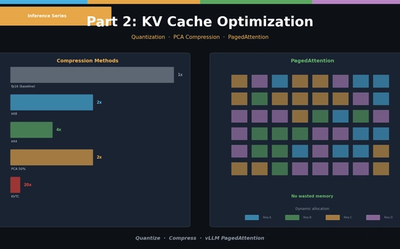
LLM Inference Optimization Part 2 — KV Cache Optimization
KV Cache quantization (int8/int4), PCA compression (KVTC), and PagedAttention (vLLM). Hands-on memory reduction code and scenario-based configuration guide.
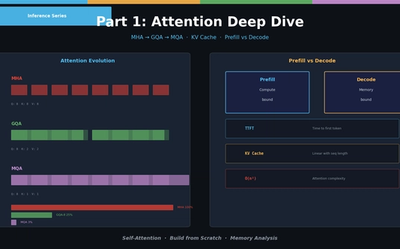
LLM Inference Optimization Part 1 — Attention Mechanism Deep Dive
Build Self-Attention from scratch. Compare MHA → GQA → MQA evolution in code. KV Cache mechanics and Prefill vs Decode analysis.
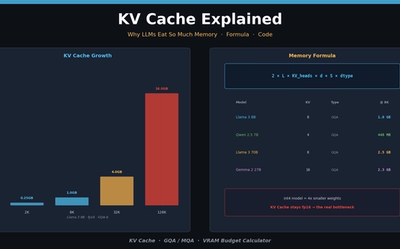
KV Cache Explained — Why LLMs Eat So Much Memory
What the KV Cache is, why it consumes so much memory, and how to calculate exact costs per model. GQA/MQA comparison, VRAM budget calculator included.