I Wanted Claude Code Running 24/7 on a Server — So I Built VibeCheck
Close your laptop, Claude Code dies. VibeCheck runs it headlessly on your server so you can access from any browser, anywhere. MIT open source.
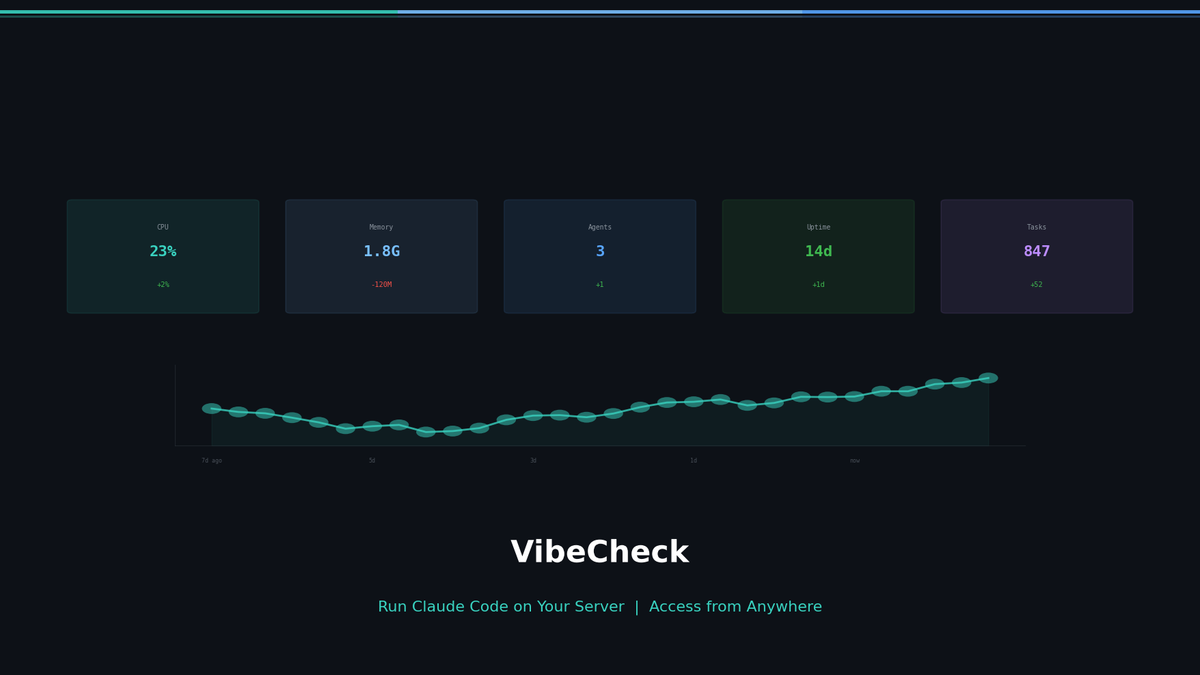
I Wanted Claude Code Running 24/7 on a Server — So I Built VibeCheck
Close your laptop, Claude Code session dies. Anthropic's Remote Control is the same — it's a local process.
"Put it on a server, access from my phone, keep it running even when the laptop is off."
That one sentence is why I built VibeCheck. It's open source (MIT).
Why I Built It
I tried Anthropic's Remote Control. Being able to see a Claude session from your phone is nice, but close the laptop and the session dies. If WiFi drops for more than 10 minutes, it times out. And you only get one session.
It's called "Remote" Control, but your computer has to stay on.
Anthropic also offers a cloud option (claude --remote), but it can't use your local environment — no local MCP servers, no environment variables, no local DB. It clones your GitHub repo and works from there, which doesn't fit projects that depend on local setup.
| Remote Control | Claude on the Web | VibeCheck | |
|---|---|---|---|
| Runs on | Your computer | Anthropic cloud | Your server |
| Laptop can sleep | No | Yes | Yes |
| Local files/MCP | Available | Not available | Available |
| Parallel sessions | 1 only | Multiple | Multiple |
| Access via | claude.ai/app | claude.ai | Any browser |
There was no option that kept the local environment while letting you close the laptop. So I built one.
Architecture
Browser (phone/laptop/tablet)
       |
       v
VibeCheck Server (WebSocket hub)
       |
       v
Your Server (vibecheck-agent + Claude Code CLI)
The agent runs Claude Code headlessly on your server and connects to a relay server via WebSocket. When you open the browser and connect to the relay, you get real-time streaming conversation.
Session history is saved in the same .jsonl format Claude Code CLI uses. Start a session on CLI, continue on the web. Start on the web, continue on CLI.
Installation
Cloud (Simplest)
Sign up at vibecheck.sotaaz.com, get your API key:
curl -sL https://vibecheck.sotaaz.com/install/YOUR_API_KEY | bashOne line. Open the browser and start coding.
Self-Hosted (Free)
git clone https://github.com/NestozAI/VibeCheck
cd VibeCheck/self-hosted
./setup.sh
Access at http://localhost:8501. Slack integration is available in the self-hosted version.
Agent Only (npm)
npm i -g vibecheck-agent
vibecheck-agent --key YOUR_API_KEY --dir /path/to/project
Requires Node.js 18+ and Claude Code CLI (claude in PATH).
Key Features
Skill Presets
Seven pre-configured agent modes for different tasks:
| Skill | Available Tools | Purpose |
|---|---|---|
| Research Agent | Read, Grep, Glob, WebSearch, WebFetch | Codebase analysis |
| Coding Agent | All tools | Writing and editing code |
| Code Review | Read, Grep, Glob | Bug, security, quality review |
| Test Runner | Read, Glob, Bash | Run tests and summarize |
| Dependency Audit | Read, Glob, Bash | Vulnerability and update checks |
| Git Summary | Read, Bash | Commit history digest |
| Doc Writer | Read, Write, Glob | README and documentation |
Task Scheduler
Cron-based recurring tasks. Daily git pulls, weekly dependency audits, scheduled test runs.
Model Selection
Switch Claude models per query. Haiku for quick questions, Sonnet for coding, Opus for complex reasoning.
Cost Tracking
Token count and USD cost displayed for every response.
Security
Path-based access control by default. Only the working directory is trusted. Access to external paths triggers an approval UI — one-time or permanent.
How I Actually Use It
I use both tools for different situations.
Quick local check-ins — Remote Control. Pull out my phone, ask "did the tests pass?"
Long-running tasks or when I want to close my laptop — VibeCheck. It runs on the server, so the work continues even after I leave.
Demo
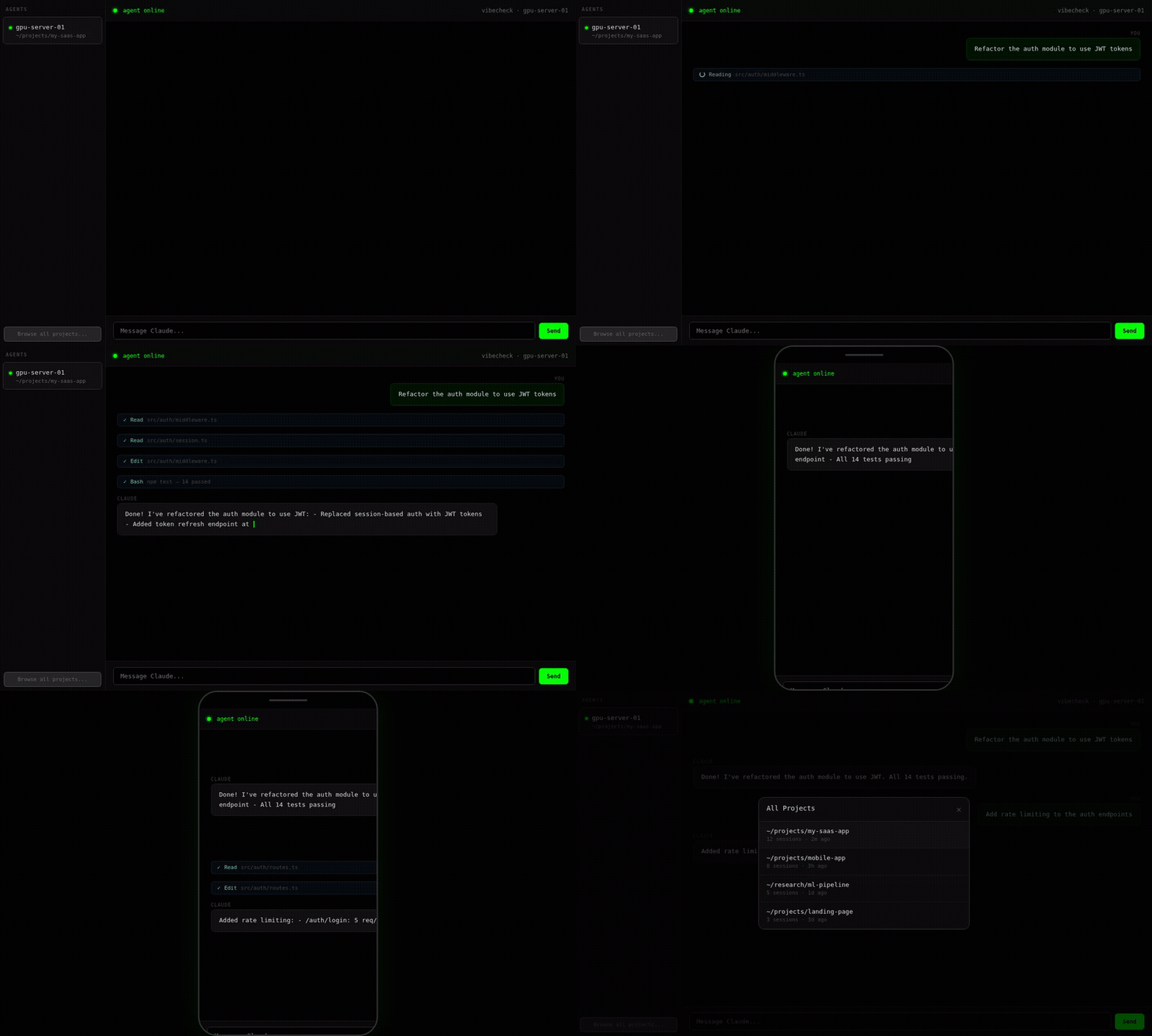
Bottom Line
Claude Code is a great tool. But "it dies when you close the laptop" is a bigger constraint than it sounds.
Put it on a server, access from your phone, keep it running with the laptop off — that's why VibeCheck exists.
- Cloud: vibecheck.sotaaz.com
- Self-hosted: github.com/NestozAI/VibeCheck
- License: MIT
References: Anthropic Remote Control Docs · Claude Code on the Web · VibeCheck GitHub
Subscribe to Newsletter
Related Posts
Paper of the Week #2 — The Score Is in the Abstract, the Bill Is in Table 2
I rebuilt HoH's Planner→Developer→QA loop (arXiv 2609.01481) around Claude Code on 8 hidden-test tasks: the score gap stayed inside rerun noise while tokens tripled, 58k vs 177k. HoH's own Table 2 reports 3.25x. Plus the matched-loss control promised in issue #1, graded.
CLAUDE.md Templates for Five Project Types — Copy, Paste, and the Rules That Actually Change Agent Behavior
Five CLAUDE.md/AGENTS.md templates — Next.js, Python ML, monorepo, data pipeline, research notebook — plus which lines agents actually obey and how to use a rules file to govern side effects.
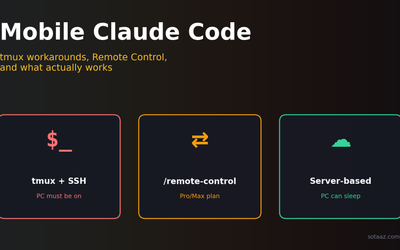
Mobile Claude Code: three approaches, and what actually works
Three ways to reach Claude Code from your phone — tmux + SSH, /remote-control, and server-based agents. The real fix isn't "mobile support" but decoupling compute from your device.