PaperBanana: AI Now Generates Publication-Quality Academic Illustrations
PaperBanana from Google and Peking University is an agentic system that automatically generates publication-ready academic illustrations from paper text.
PaperBanana: AI Now Generates Publication-Quality Academic Illustrations
What's the most time-consuming part of writing a paper? Experiments? Writing? Many researchers point to "creating figures." Methodology diagrams, architecture schematics, result visualizations... each one can take hours or even days.
Researchers from Google and Peking University have released PaperBanana to solve this problem. It's an agentic system that automatically generates publication-ready academic illustrations from paper text alone.
Why Is This Needed?
We're in an era where LLMs help with paper writing, code generation, and experiment design. But figures? We still manually create them in PowerPoint, Figma, or TikZ.
- Half a day for one methodology diagram
- Start over when revision requests come in
- Maintaining consistent style is challenging
PaperBanana addresses this bottleneck.
How Does It Work?
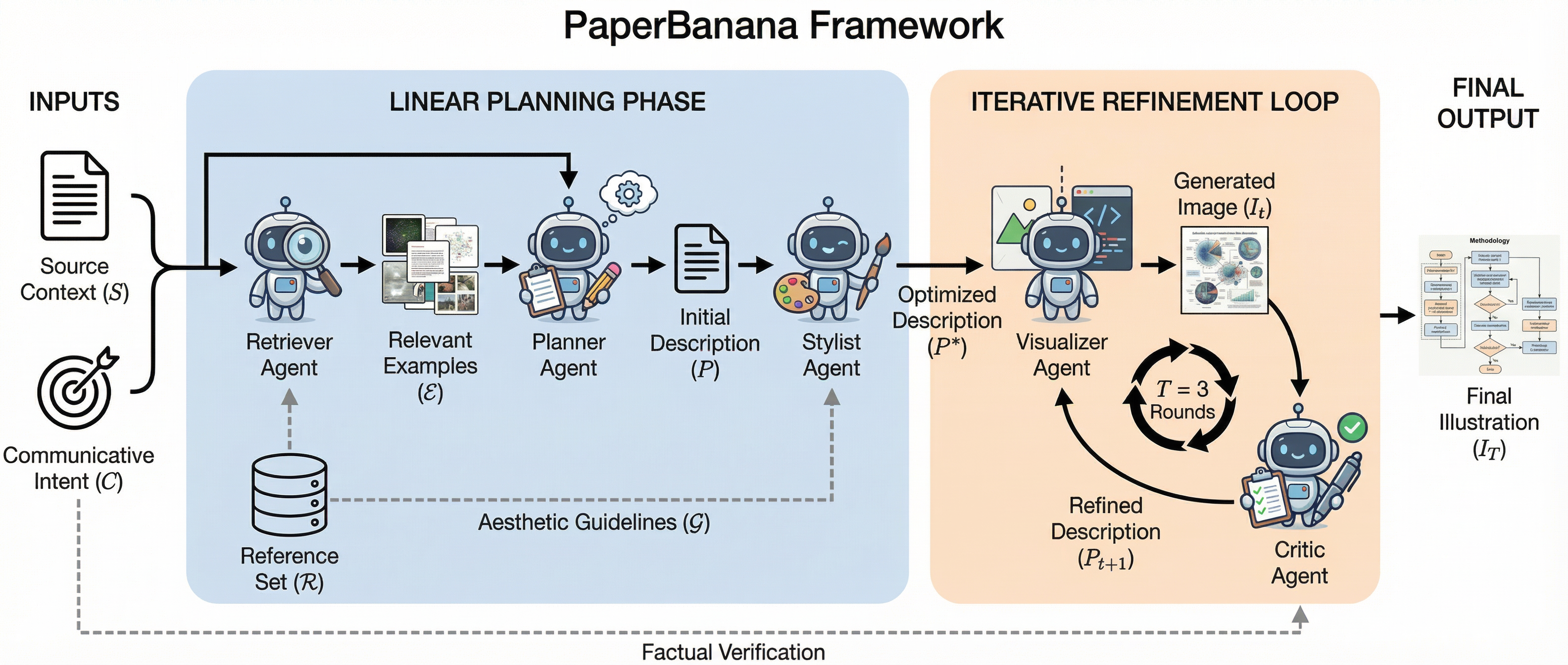
PaperBanana uses four specialized agents working in collaboration:
1. Reference Retrieval Agent
- Searches figure styles from similar papers
- Identifies visual conventions in the field
- Collects reference layout patterns
2. Content Planning Agent
- Extracts key concepts from paper text
- Decides which elements to include
- Designs information hierarchy
3. Image Rendering Agent
- Leverages Vision-Language Models
- Generates actual images
- Places text, arrows, boxes, etc.
4. Iterative Refinement Agent
- Self-evaluates generated figures
- Identifies areas for improvement
- Iterates until quality criteria are met
Performance: PaperBananaBench
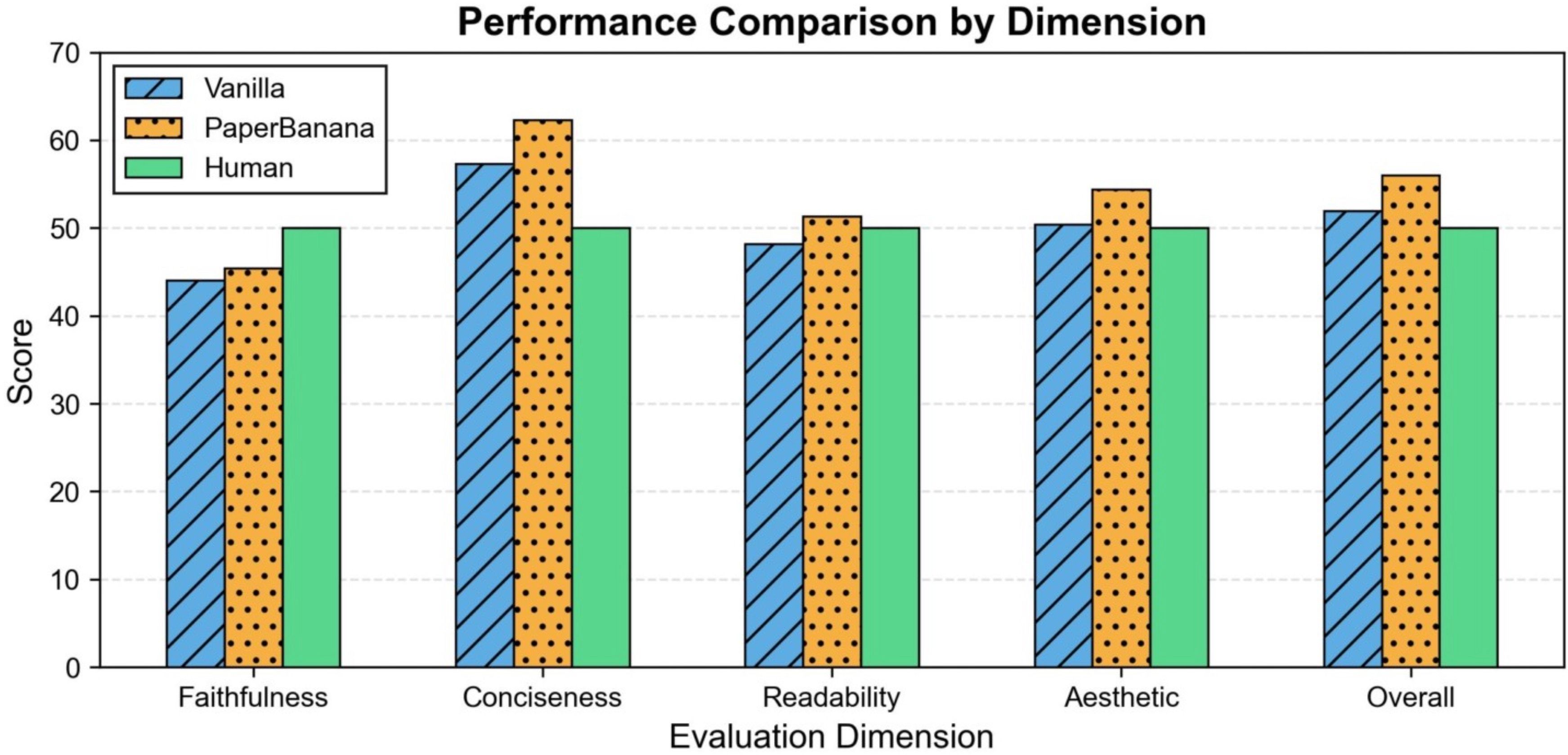
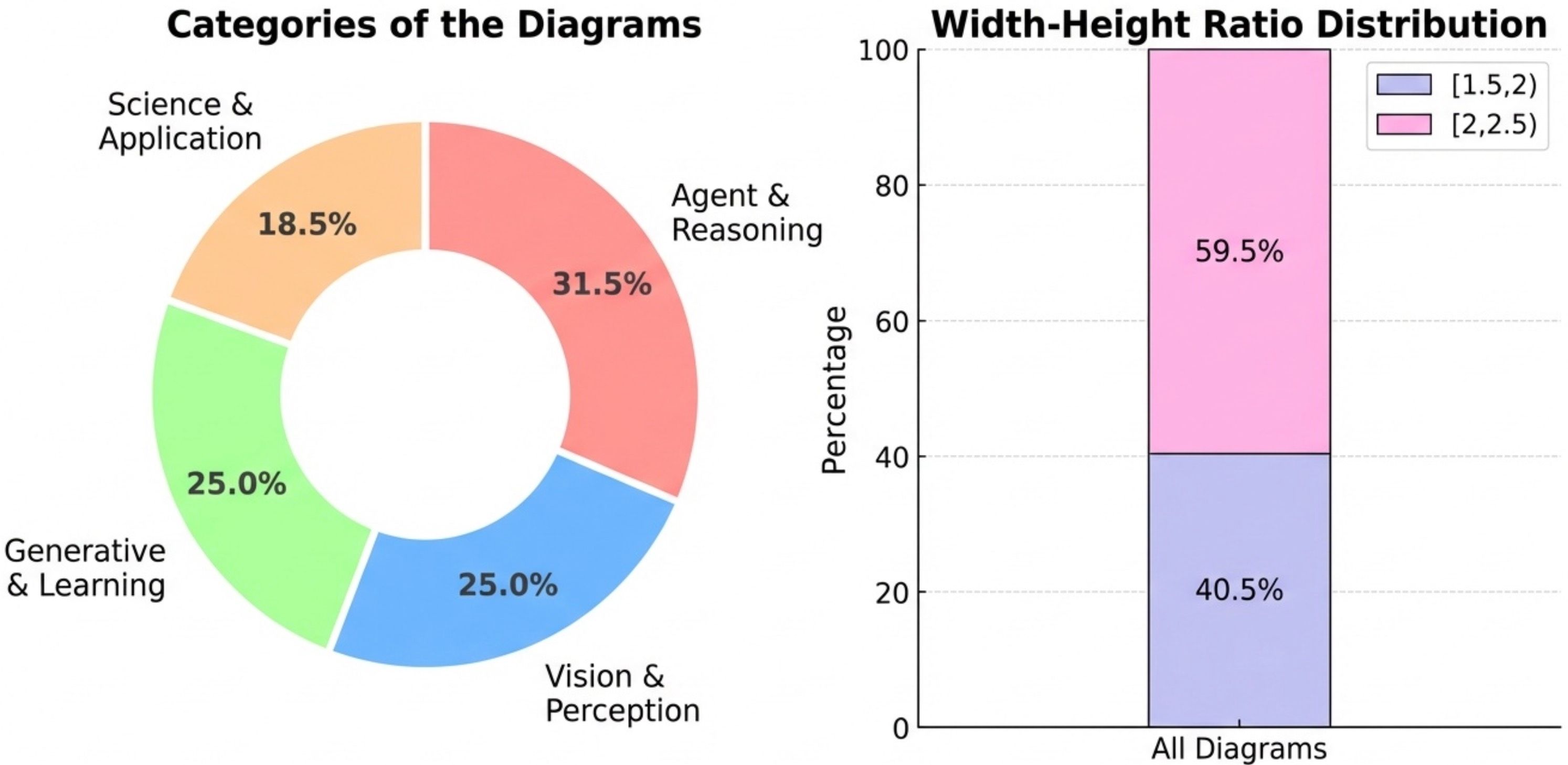
The team created a benchmark with 292 test cases collected from NeurIPS 2025 papers.
Evaluation criteria:
- Faithfulness: Does it match the paper content?
- Conciseness: Is it free of unnecessary elements?
- Readability: Is it easy to understand?
- Aesthetics: Does it look visually appealing?
PaperBanana outperformed existing methods across all criteria.
Extended Capabilities
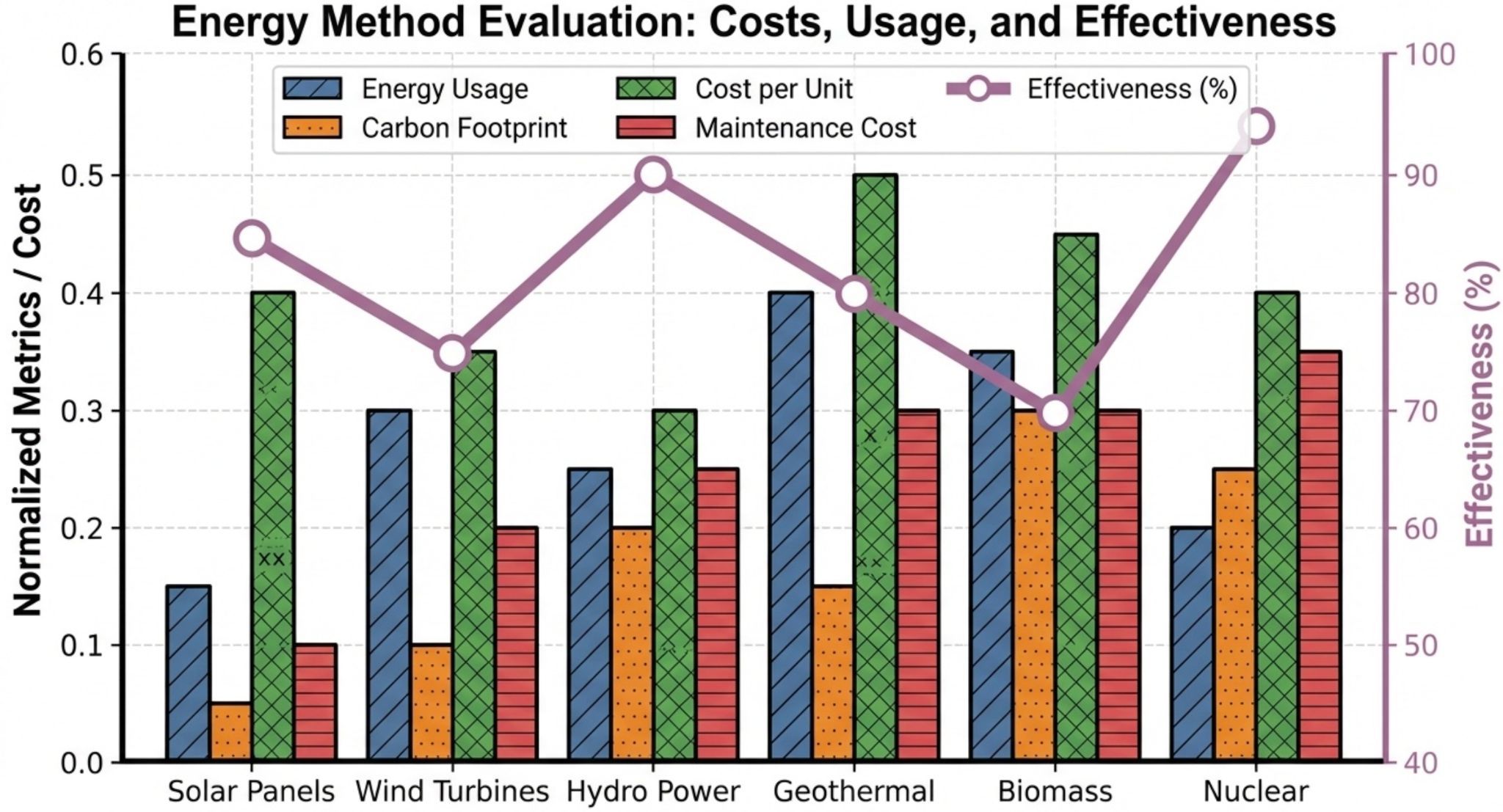
Beyond methodology diagrams, it can also generate statistical plots:
- Experimental result graphs
- Comparison charts
- Data distribution visualizations
Limitations and Outlook
Current limitations:
- Complex 3D structures remain challenging
- Limited support for domain-specific notations
- Generation takes several minutes
However, it's significant as the final piece of AI research workflow automation. We're approaching an era where the entire paper writing process can be AI-assisted.
Resources
- Paper: PaperBanana: Automating Academic Illustration for AI Scientists
- Authors: Google Research, Peking University
Subscribe to Newsletter
Related Posts
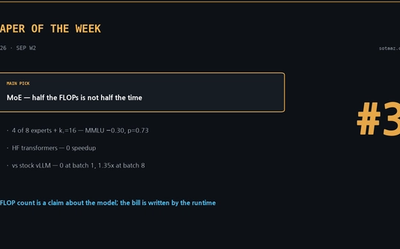
Paper of the Week #3 — Half the FLOPs Is Not Half the Time
One integer halves a fine-grained MoE's expert compute (arXiv 2609.04575) and its Table 5 replicates on one A100 to within a point. The paper never reports time, so I measured it: nothing in HF transformers, nothing at batch 1 in the vLLM you run today, 1.35x at batch 8. Plus the OLMoE control and the iso-cost harness control promised in issue #2.
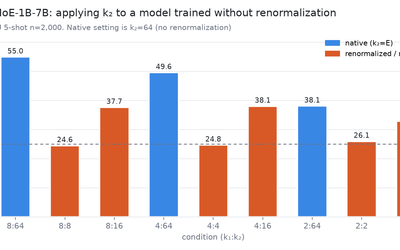
The paper stopped at half the experts. A quarter loses four points instead of thirty, and a model trained without renormalization tells you why.
Two cells arXiv:2609.04575 never ran: k₁=2 and k₁=3 on Qwen3.6-35B-A3B, and the whole k₂ trick on OLMoE, which was trained without renormalization. The second one is a clean test of the paper's mechanism.
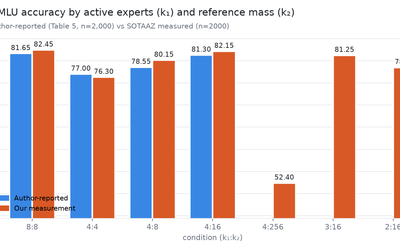
One integer halves MoE expert compute. We measured the speed the paper didn't: free at batch 8, not at batch 1.
We reproduced Table 5 of arXiv:2609.04575 on one A100 and measured the throughput the paper leaves out: nothing in HF transformers, nothing at batch 1 in stock vLLM, 1.35× at batch 8.