Multi-hop RAG: Why It Still Fails After Temporal RAG
You added Temporal RAG, but "who is my boss's boss?" still returns wrong answers. RAG now understands time, but it still doesn't know "what to search for next."
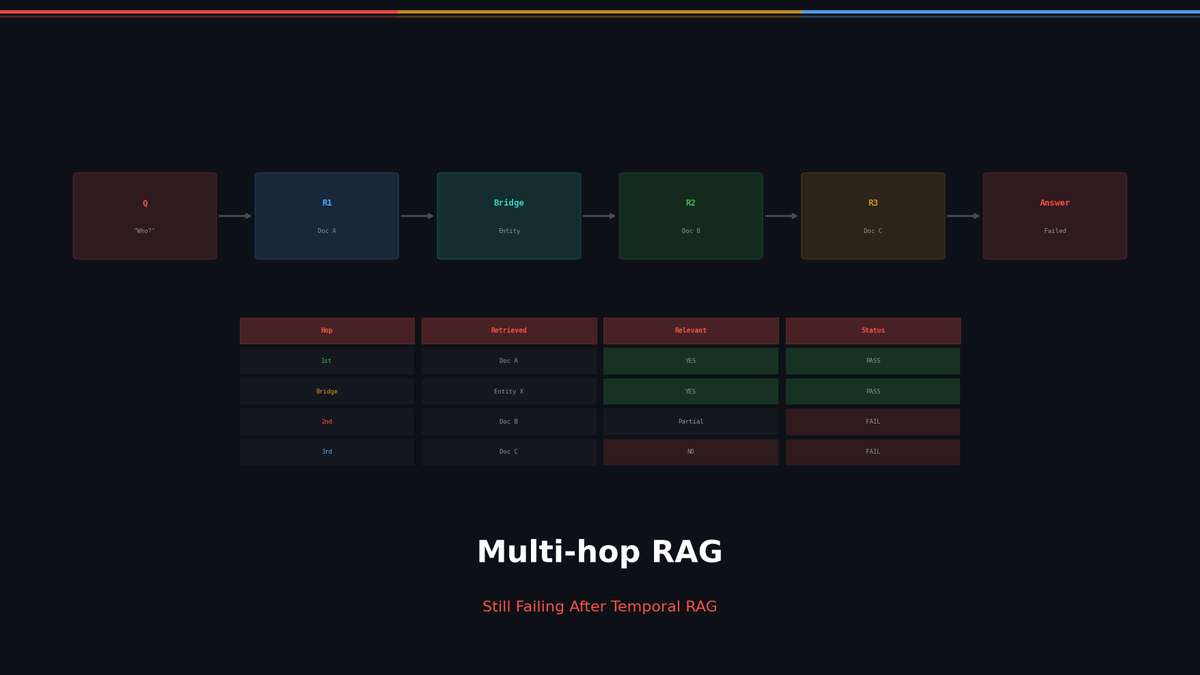
Multi-hop RAG: Why It Still Fails After Temporal RAG
You added Temporal RAG, but "who is my boss's boss?" still returns wrong answers. RAG now understands time, but it still doesn't know "what to search for next."
Redefining the Problem: Single-hop vs Multi-hop
The conventional explanation goes:
"Single-hop is easy, Multi-hop is hard"
Related Posts
TurboQuant in vLLM on One A100 — Capacity, Speed, and Accuracy of All Four Presets on an 8B Model
vLLM 0.28, Qwen3-8B bf16, one A100 80GB: KV capacity, batched throughput, 32K decode, needle-in-haystack, and GSM8K for bf16, fp8, and all four TurboQuant presets — the 8B size vLLM's own study skipped.
TurboQuant From Scratch on Real KV Tensors — What 3 Bits Actually Cost, and Why the Forks Beat the Paper's Layout
PolarQuant in 60 lines of PyTorch on real KV from Llama-3.2-1B and Qwen3-8B: 3-bit costs +10% perplexity, k8v4 +0.2%, QJL only pays below 4 bits, and the block-32 layout explains half the forks' edge.
TurboQuant llama.cpp CUDA Fork, Measured on an A100 — turbo4 Matches q4_0, turbo3 Breaks at Long Context
Qwen3-8B Q4_K_M on one A100, six KV types: perplexity, prefill, decode-at-depth, and VRAM measured. turbo4 matches q4_0 quality and beats q8_0 decode 2.5x at depth; turbo3 triples perplexity at 32K context.