Can Diffusion Replace Autoregressive LLMs? The Complete LLaDA 2.X Guide
From DDPM to LLaDA 2.1 -- everything about diffusion-based LLMs. Masked Diffusion, Token Editing, and MoE scaling dissected across 4 parts.
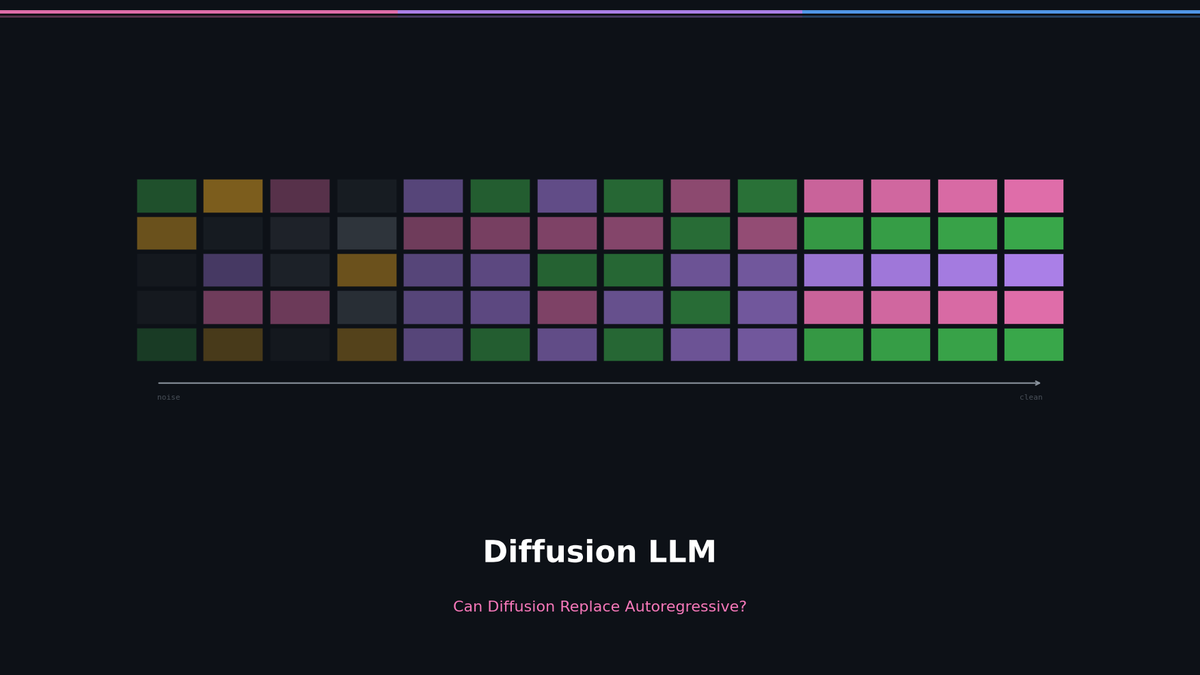
Can Diffusion Replace the LLM? A Complete Anatomy of LLaDA 2.X
ChatGPT, Claude, Gemini — every large language model (LLM) we use today is built on a single principle. Autoregressive (AR) generation: left to right, one token at a time, predicting the next word.
This approach works remarkably well. But it has structural limitations.
- Tokens must be produced one at a time in sequence, making parallel generation impossible
- Even if the model knows "A is B," it cannot infer "B is A" — the Reversal Curse
- Because it only looks left to right, it cannot leverage right-side context
But what if we built an LLM using Diffusion?
Just as Stable Diffusion and DALL-E demonstrated in image generation — starting from noise and progressively refining toward a clean result — what if we could apply the same Diffusion approach to text?
In February 2025, a research team from HKU/PKU published LLaDA (Large Language Diffusion with mAsking), turning this possibility into reality. Then in late 2025, Ant Group's InclusionAI scaled up to 100B parameters with LLaDA 2.0, and in February 2026, LLaDA 2.1 solved the speed problem with an innovation called Token Editing.
This series fully dissects everything from the fundamentals of Diffusion to the latest techniques in LLaDA 2.1, across 4 parts.
Why Diffusion LLMs?
The core premise of Autoregressive models is simple: text is generated left to right.
P(x) = P(x_1) * P(x_2|x_1) * P(x_3|x_1,x_2) * ...
This assumption keeps training straightforward and scaling clean. But the structural weaknesses are equally clear.
Speed bottleneck: To generate 1000 tokens, the model must be called 1000 times sequentially. Each step re-processes the entire context. KV-cache mitigates this, but fundamentally, O(n) sequential calls are unavoidable.
Unidirectional dependency: The model only sees left context. Even if it learns "Tom Cruise's mother is Mary Lee Pfeiffer," it struggles to answer "Who is Mary Lee Pfeiffer's son?" This is the Reversal Curse.
No revision: AR models cannot go back and fix tokens they have already generated. Even when they spot a mistake, they can only move forward.
Diffusion models approach all three of these differently.
- All tokens are generated simultaneously and progressively refined (parallel generation)
- Context is leveraged bidirectionally (mitigating the Reversal Curse)
- Results are revised across multiple steps (iterative refinement)
LLaDA Series Timeline
| Date | Model | Key Contribution |
|---|---|---|
| 2025.02 | LLaDA 8B | First large-scale Diffusion LLM. Masked Diffusion + Transformer |
| 2025.11 | LLaDA 2.0-mini (16B) | Introduces MoE architecture. 1.4B active parameters |
| 2025.11 | LLaDA 2.0-flash (100B) | First 100B Diffusion LLM. 6.1B active parameters |
| 2026.02 | LLaDA 2.1-mini (16B) | Token Editing (T2T + M2T). S-Mode / Q-Mode |
| 2026.02 | LLaDA 2.1-flash (100B) | RL Framework + Token Editing. 892 TPS achieved |
Series Overview
Part 1: Diffusion Fundamentals — From DDPM to Score Matching
We cover the core principles of Diffusion, proven in image generation. The forward process (adding noise), the reverse process (removing noise), the ELBO training objective, and the connection to score matching. After reading this part, you will have a mathematical understanding of why Diffusion works.
Key terms: DDPM, Forward/Reverse Process, ELBO, Score Function, SDE
Part 2: Discrete Diffusion — How Do You Add Noise to Text?
We explore how to apply continuous-space Diffusion to discrete tokens. D3PM's Transition Matrix, the point where Absorbing State meets BERT's [MASK], and MDLM's simplifications. This part explains how the gap between images and text is bridged.
Key terms: D3PM, Transition Matrix, Absorbing State, MDLM, Masked Diffusion
Part 3: LLaDA — Building an 8B LLM with Masked Diffusion
We examine how LLaDA scaled Masked Diffusion to an 8B-parameter LLM. The meaning of variable masking ratio, why In-Context Learning is possible, and the structural advantages that avoid the Reversal Curse. We analyze head-to-head comparison results against LLaMA3 8B.
Key terms: Variable Masking, ELBO Training, Scaling Law, Reversal Curse, In-Context Learning
Part 4: LLaDA 2.0 -> 2.1 — Breaking 100B with MoE + Token Editing
We cover LLaDA 2.0's MoE scaling and LLaDA 2.1's Token Editing innovation. The T2T (Token-to-Token) + M2T (Mask-to-Token) hybrid, the speed-quality tradeoff of S-Mode/Q-Mode, and the first large-scale RL Framework for Diffusion LLMs.
Key terms: MoE, CAP Decoding, Token Editing, T2T+M2T, S-Mode/Q-Mode, RL for dLLMs
Benchmark Scorecard
LLaDA 2.0-flash (100B, 6.1B active) vs major Autoregressive models:
| Benchmark | LLaDA 2.0-flash | Qwen3-30B-A3B |
|---|---|---|
| MMLU | 87.69 | - |
| MMLU-Pro | 73.36 | - |
| GPQA | 61.98 | - |
| HumanEval | 94.51 | - |
| GSM8K | 96.06 | - |
| MATH | 95.44 | - |
| AIME 2025 | 60.00 | - |
| IFEval-strict | 81.70 | - |
| Overall Average | 79.32 | 79.47 |
The notable takeaway: a 100B Diffusion model has reached parity with similarly-sized AR models. The conventional wisdom that "Diffusion LLMs cannot match AR" is being overturned.
LLaDA 2.1-flash speed:
| Task | Throughput (TPS) |
|---|---|
| HumanEval+ | 892 |
| BigCodeBench | 801 |
| LiveCodeBench | 663 |
AR vs Diffusion: Key Differences at a Glance
| Property | Autoregressive | Diffusion (LLaDA) |
|---|---|---|
| Generation direction | Left -> right sequential | Simultaneous generation then refinement |
| Context utilization | Unidirectional (left only) | Bidirectional |
| Reversal Curse | Vulnerable | Structurally avoided |
| Parallel generation | Impossible (1 token/step) | Possible (all tokens at once) |
| KV-Cache | Required (speed optimization) | Not needed (different optimization path) |
| Training objective | Next-token prediction | ELBO (likelihood lower bound) |
| Output revision | Impossible (once generated, final) | Possible (iterative denoising) |
What This Series Does Not Cover
- Detailed architectures of image Diffusion models such as Stable Diffusion and DALL-E
- Latest optimization techniques for Autoregressive models (e.g., Speculative Decoding)
- Diffusion LLMs other than LLaDA (PLAID, Diffusion-LM, etc.) are mentioned only as background
References
- Ho, Jain, Abbeel. "Denoising Diffusion Probabilistic Models." NeurIPS 2020.
- Song et al. "Score-Based Generative Modeling through Stochastic Differential Equations." ICLR 2021.
- Austin et al. "Structured Denoising Diffusion Models in Discrete State-Spaces." NeurIPS 2021.
- Sahoo et al. "Simple and Effective Masked Diffusion Language Models." NeurIPS 2024.
- Nie et al. "Large Language Diffusion Models." arXiv:2502.09992, 2025.
- InclusionAI. "LLaDA 2.0 Technical Report." 2025.
- InclusionAI. "LLaDA 2.1: Speeding Up Text Diffusion via Token Editing." arXiv:2602.08676, 2026.
Subscribe to Newsletter
Related Posts
Paper of the Week #3 — Half the FLOPs Is Not Half the Time
One integer halves a fine-grained MoE's expert compute (arXiv 2609.04575) and its Table 5 replicates on one A100 to within a point. The paper never reports time, so I measured it: nothing in HF transformers, nothing at batch 1 in the vLLM you run today, 1.35x at batch 8. Plus the OLMoE control and the iso-cost harness control promised in issue #2.
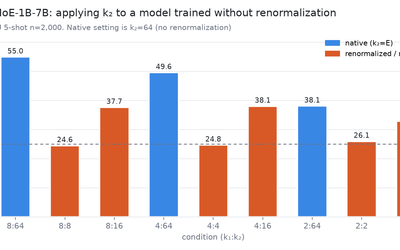
The paper stopped at half the experts. A quarter loses four points instead of thirty, and a model trained without renormalization tells you why.
Two cells arXiv:2609.04575 never ran: k₁=2 and k₁=3 on Qwen3.6-35B-A3B, and the whole k₂ trick on OLMoE, which was trained without renormalization. The second one is a clean test of the paper's mechanism.
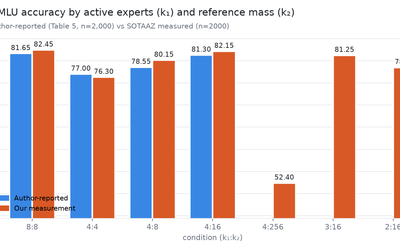
One integer halves MoE expert compute. We measured the speed the paper didn't: free at batch 8, not at batch 1.
We reproduced Table 5 of arXiv:2609.04575 on one A100 and measured the throughput the paper leaves out: nothing in HF transformers, nothing at batch 1 in stock vLLM, 1.35× at batch 8.