AgentScope vs LangGraph vs CrewAI — 2026 Multi-Agent Framework Comparison
Full comparison of AgentScope (Alibaba), LangGraph (LangChain), and CrewAI with real data and code examples. Architecture, LLM support, multimodal, memory, and production deployment.
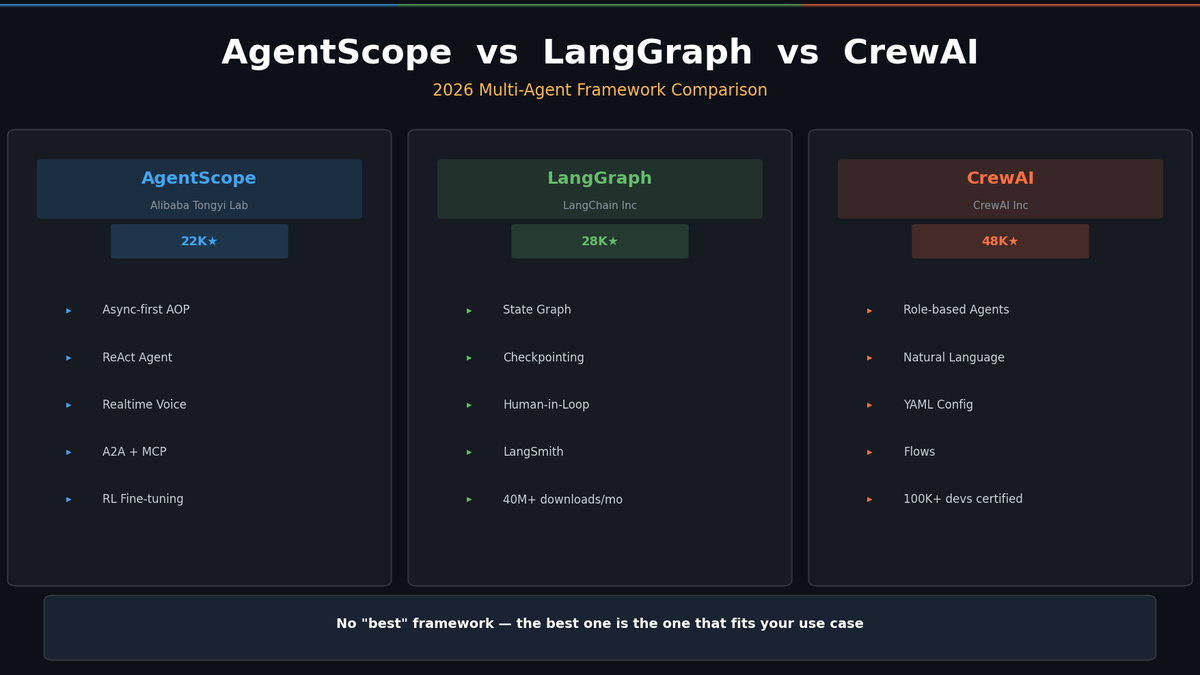
AgentScope vs LangGraph vs CrewAI — 2026 Multi-Agent Framework Comparison
In 2026, choosing an AI agent framework has become one of the most frequently asked questions in the developer community.
This article compares the three most popular frameworks using real data and code examples:
- AgentScope — Alibaba's agent-oriented programming framework
- LangGraph — LangChain's graph-based workflow engine
- CrewAI — Role-based multi-agent orchestration
1. 30-Second Summary
| AgentScope | LangGraph | CrewAI | |
|---|---|---|---|
| One-liner | Agent-Oriented Programming framework | Graph-based agent workflow engine | Role-based multi-agent orchestration |
| Creator | Alibaba Tongyi Lab | LangChain Inc | CrewAI Inc (Joao Moura) |
| GitHub Stars | 22K+ | 28K+ | 48K+ |
| PyPI Monthly Downloads | — | 40.4M | 6.4M |
| Latest Version | v1.0.18 (Mar 2026) | v1.1.3 (Mar 2026) | v1.12.2 (Mar 2026) |
| License | Apache 2.0 | MIT | MIT |
| Core Metaphor | Async agents + pipelines | State machine graph | AI team role-play |
2. Architecture Comparison
AgentScope: Agent-Oriented Programming
AgentScope's philosophy is Agent-Oriented Programming (AOP) — treating agents as first-class objects.
from agentscope.agent import ReActAgent, UserAgent
from agentscope.model import OpenAIChatModel
from agentscope.memory import InMemoryMemory
from agentscope.tool import Toolkit, execute_python_code
import asyncio

async def main():
    toolkit = Toolkit()
    toolkit.register_tool_function(execute_python_code)

    agent = ReActAgent(
        name="Friday",
        sys_prompt="You're a helpful assistant.",
        model=OpenAIChatModel(model_name="gpt-4o", api_key="..."),
        memory=InMemoryMemory(),
        toolkit=toolkit,
    )
    user = UserAgent(name="user")

    msg = None
    while True:
        msg = await agent(msg)
        msg = await user(msg)

asyncio.run(main())
Key characteristics:
- Fully async/await architecture — every agent call is asynchronous
- ReActAgent — built-in reasoning + action loop
- Pipelines — compose agents with SequentialPipeline, FanoutPipeline
- MsgHub — broadcast-based group conversations
LangGraph: State Graph Machine
LangGraph models agent workflows as directed graphs.
from typing import TypedDict
from langgraph.graph import StateGraph, START, END
from langchain_openai import ChatOpenAI

class State(TypedDict):
    topic: str
    research: str
    draft: str

llm = ChatOpenAI(model="gpt-4o")

def researcher(state: State) -> dict:
    result = llm.invoke(f"Research: {state['topic']}")
    return {"research": result.content}

def writer(state: State) -> dict:
    result = llm.invoke(f"Write using: {state['research']}")
    return {"draft": result.content}

graph = StateGraph(State)
graph.add_node("researcher", researcher)
graph.add_node("writer", writer)
graph.add_edge(START, "researcher")
graph.add_edge("researcher", "writer")
graph.add_edge("writer", END)

app = graph.compile()
result = app.invoke({"topic": "AI agents"})
Key characteristics:
- StateGraph — define state schemas with TypedDict/Pydantic
- Nodes — Python functions that read and write state
- Conditional Edges — dynamic branching based on state
- Checkpointing — automatic persistence to Postgres/SQLite
CrewAI: Role-Play Teams
CrewAI defines agents as team members with roles, goals, and backstories in natural language.
from crewai import Agent, Task, Crew, Process

researcher = Agent(
    role="Senior Researcher",
    goal="Research thoroughly on {topic}",
    backstory="Expert research analyst with 10 years of experience"
)
writer = Agent(
    role="Technical Writer",
    goal="Write clear, engaging articles",
    backstory="Experienced tech writer specializing in AI"
)
research_task = Task(
    description="Research {topic}",
    expected_output="Detailed research notes",
    agent=researcher
)
write_task = Task(
    description="Write article from research",
    expected_output="Publication-ready article",
    agent=writer
)
crew = Crew(
    agents=[researcher, writer],
    tasks=[research_task, write_task],
    process=Process.sequential
)
result = crew.kickoff(inputs={"topic": "AI agents"})
Key characteristics:
- Agent = Role + Goal + Backstory — natural language personas
- Task — description + expected output + assigned agent
- Crew — agent team with Sequential or Hierarchical process
- Delegation — agents can delegate subtasks to each other
3. Feature Comparison
3-1. LLM Support
| Provider | AgentScope | LangGraph | CrewAI |
|---|---|---|---|
| OpenAI (GPT-4o, o3) | ✅ | ✅ | ✅ (default) |
| Anthropic (Claude) | ✅ | ✅ | ✅ |
| Google (Gemini) | ✅ | ✅ | ✅ |
| Alibaba (Qwen) | ✅ (DashScope) | ✅ (via LangChain) | ✅ (via API) |
| Ollama (local) | ✅ | ✅ | ✅ |
| DeepSeek | ✅ | ✅ | ✅ |
All three frameworks support major LLMs. AgentScope has the deepest DashScope (Alibaba) integration, while LangGraph has the broadest via LangChain.
3-2. Multimodal
| Feature | AgentScope | LangGraph | CrewAI |
|---|---|---|---|
| Image generation | ✅ (built-in tools) | ⚠️ (custom) | ⚠️ (custom) |
| TTS (Text-to-Speech) | ✅ (6 TTS models) | ❌ | ❌ |
| Voice input | ✅ (Realtime Agent) | ❌ | ❌ |
| Realtime voice chat | ✅ (OpenAI/Gemini/DashScope) | ❌ | ❌ |
AgentScope dominates multimodal. It supports Realtime APIs from OpenAI, Gemini, and DashScope, plus 6 TTS model variants.
3-3. Memory System
| Feature | AgentScope | LangGraph | CrewAI |
|---|---|---|---|
| Short-term memory | ✅ (In-Memory, Redis, SQL) | ✅ (State + Checkpoint) | ✅ (built-in) |
| Long-term memory | ✅ (Mem0, ReMe) | ✅ (Cross-thread store) | ✅ (ChromaDB) |
| Memory compression | ✅ (auto-compress) | ❌ | ❌ |
| Vector store | ✅ (Qdrant, Milvus, MongoDB) | ⚠️ (external) | ✅ (ChromaDB built-in) |
3-4. Protocol Support
| Protocol | AgentScope | LangGraph | CrewAI |
|---|---|---|---|
| MCP (Model Context Protocol) | ✅ (HTTP + Stdio) | ⚠️ (community) | ✅ (built-in) |
| A2A (Agent-to-Agent) | ✅ (built-in) | ❌ | ❌ |
AgentScope is one of the few frameworks with official Google A2A protocol support.
3-5. Production Deployment
| Feature | AgentScope | LangGraph | CrewAI |
|---|---|---|---|
| Checkpointing/Recovery | ⚠️ (session-based) | ✅ (best-in-class) | ⚠️ (Flows) |
| Distributed execution | ✅ (agentscope-runtime) | ✅ (LangGraph Platform) | ⚠️ (limited) |
| Monitoring | ✅ (OpenTelemetry native) | ✅ (LangSmith) | ✅ (Control Plane) |
| Sandbox execution | ✅ (Docker + VNC) | ⚠️ (external) | ❌ |
| JS/TS support | ✅ (agentscope-typescript) | ✅ (LangGraph.js) | ❌ |
4. Learning Curve
Easy ◄────────────────────────────────────► Hard

CrewAI           AgentScope          LangGraph
  │                  │                    │
  ▼                  ▼                    ▼
Define roles       Agent + Pipeline    StateGraph design
Natural language   async/await needed  Nodes/Edges/State
10min quickstart 20min quickstart 30min+ quickstart| Aspect | AgentScope | LangGraph | CrewAI |
|---|---|---|---|
| Time to first agent | ~20 min | ~30 min | ~10 min |
| Mental model | OOP + async | Graph theory + state machine | Team/role metaphor |
| Complex workflows | Pipeline composition | Graph is natural | Needs Flows |
| Documentation | Good (Chinese bias) | Comprehensive (LangChain ecosystem) | Self-contained |
5. Ecosystem Scale
AgentScope Ecosystem (19 repos)
| Project | Stars | Description |
|---|---|---|
| agentscope | 22K+ | Core framework |
| CoPaw | 13.7K | Personal AI assistant |
| HiClaw | 3.4K | Multi-agent OS |
| ReMe | 2.5K | Agent memory management |
| agentscope-java | 2.3K | Java implementation |
| agentscope-runtime | 677 | Production runtime |
| Trinity-RFT | 574 | RL fine-tuning |
| OpenJudge | 502 | Evaluation framework |
| agentscope-studio | 484 | Visualization toolkit |
Total ecosystem stars: 46K+ — while the core is 22K, the full ecosystem matches CrewAI-level adoption.
LangGraph Ecosystem
- LangChain (97K+ stars) — parent framework
- LangSmith — monitoring/tracing platform
- LangGraph.js (2.7K stars) — TypeScript implementation
- LangChain Academy — free courses
CrewAI Ecosystem
- crewai (48K stars) — core + tools monorepo
- Crew Control Plane — monitoring platform
- learn.crewai.com — certification program (100K+ developers)
6. Hidden Costs and Gotchas
AgentScope
- DashScope bias — heavy Alibaba service dependency for TTS, multimodal embeddings
- Async-only — no synchronous API; even simple scripts need
asyncio.run() - Chinese-leaning docs — some issues and documentation in Chinese
- Python 3.10+ — no 3.9 or earlier support
LangGraph
- LangChain dependency —
langchain-coreis a required dependency - Boilerplate — even simple tasks need state schemas, nodes, and edge definitions
- Debugging difficulty — hard to trace state transitions in complex graphs without LangSmith
- Postgres checkpoint SSL issues — long-standing unresolved bug
CrewAI
- Heavy dependencies — ChromaDB, LanceDB, OpenTelemetry bundled in core. Package size 968KB vs LangGraph's 168KB
- Default telemetry — collects agent roles, tool names by default (must be disabled)
- OpenAI hard dependency —
openaipackage required even when using other providers - PR backlog — 387 open PRs suggesting potential review bottleneck
7. Decision Guide
Choose AgentScope when:
- Building realtime voice agents
- Need A2A protocol for cross-framework agent communication
- Primarily using Alibaba DashScope/Qwen ecosystem
- Want RL fine-tuning to improve agent performance
- Building multimodal agents (image + voice + text)
Choose LangGraph when:
- Complex branching logic in workflows
- Checkpointing/recovery is a core requirement
- Frequent human-in-the-loop interactions
- Already using the LangChain ecosystem
- Building agents in TypeScript
Choose CrewAI when:
- Rapid prototyping is the priority
- Team members are new to LLM/agents
- Role-based multi-agent scenarios (research team, content team)
- Need a demo with minimal code
- Want YAML-based agent configuration
8. Final Comparison Matrix
| Category | AgentScope | LangGraph | CrewAI |
|---|---|---|---|
| Getting started | ⭐⭐⭐ | ⭐⭐ | ⭐⭐⭐⭐⭐ |
| Complex workflows | ⭐⭐⭐⭐ | ⭐⭐⭐⭐⭐ | ⭐⭐⭐ |
| Multimodal | ⭐⭐⭐⭐⭐ | ⭐⭐ | ⭐⭐ |
| Production readiness | ⭐⭐⭐⭐ | ⭐⭐⭐⭐⭐ | ⭐⭐⭐ |
| Ecosystem size | ⭐⭐⭐⭐ | ⭐⭐⭐⭐⭐ | ⭐⭐⭐ |
| Documentation | ⭐⭐⭐ | ⭐⭐⭐⭐ | ⭐⭐⭐⭐ |
| Community activity | ⭐⭐⭐ | ⭐⭐⭐⭐⭐ | ⭐⭐⭐⭐ |
| Flexibility | ⭐⭐⭐⭐⭐ | ⭐⭐⭐⭐ | ⭐⭐⭐ |
Conclusion
These three frameworks solve different problems in different ways:
- AgentScope = Research-oriented + multimodal + for developers who want to design agent systems from scratch
- LangGraph = Production-oriented + complex state management + for LangChain users
- CrewAI = Quick start + intuitive API + team-based agent scenarios
There is no "best framework." The best one is the one that fits your use case.
Subscribe to Newsletter
Related Posts
Paperclip — The Open-Source Framework for Running AI Agent Companies
30K GitHub stars in 3 weeks. An open-source multi-agent orchestration platform with org charts, budgets, and governance. Heartbeat scheduling, per-agent monthly budgets, and company templates.
AgentScope Production Deployment — Runtime, Monitoring, Scaling
Docker deployment with agentscope-runtime, OpenTelemetry tracing, AgentScope Studio, RL fine-tuning, production checklist.
AgentScope Realtime Voice Agents — Build 3 Voice AI Apps
Build 3 real voice AI apps — chatbot, simultaneous interpreter, and customer service bot with RealtimeAgent + Gradio.