Hybrid Mamba-Transformer, Measured: Qwen3.5-9B's Cache Is 4.4x Smaller Than Qwen3-8B's — and Why Our Speed Numbers Don't Count
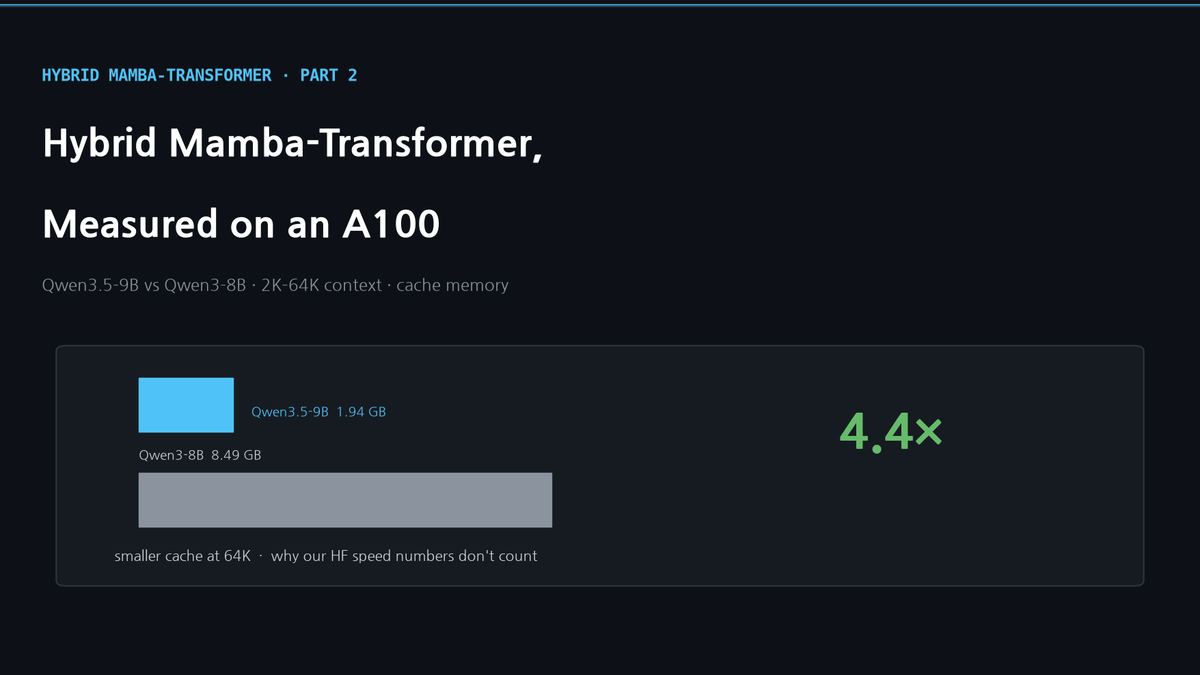
Cache memory of Qwen3.5-9B (24 linear + 8 attention layers) vs Qwen3-8B measured from 2K to 64K context on one A100: 4.4x smaller at 64K, converging to 4.6x, and it decomposes exactly. Plus why HF eager speed numbers can't judge the architecture.
Hybrid Mamba-Transformer, Measured: Qwen3.5-9B's Cache Is 4.4x Smaller Than Qwen3-8B's — and Why Our Speed Numbers Don't Count
Our first post on hybrid Mamba-Transformer models argued from three papers that the 2026 convergence — three quarters linear layers, one quarter attention — buys a much smaller inference cache and faster long-context decoding. It cited "~25% of full KV cache" and "~2–3x inference speed" from the papers. This post checks the first claim on hardware we control and explains, carefully, why we can only *partly* check the second.
Setup: Qwen3.5-9B (32 layers: 24 Gated DeltaNet + 8 full attention, full_attention_interval=4) against Qwen3-8B (36 layers, all attention), both bf16, one A100 80GB, batch 1, contexts from 2K to 64K tokens, HuggingFace Transformers 5.16 with the flash-linear-attention Triton kernels. We measure the cache — key/value tensors for attention layers, recurrent and convolution state for linear layers — by summing every tensor in the cache object, not by reading GPU memory (which would include logits).
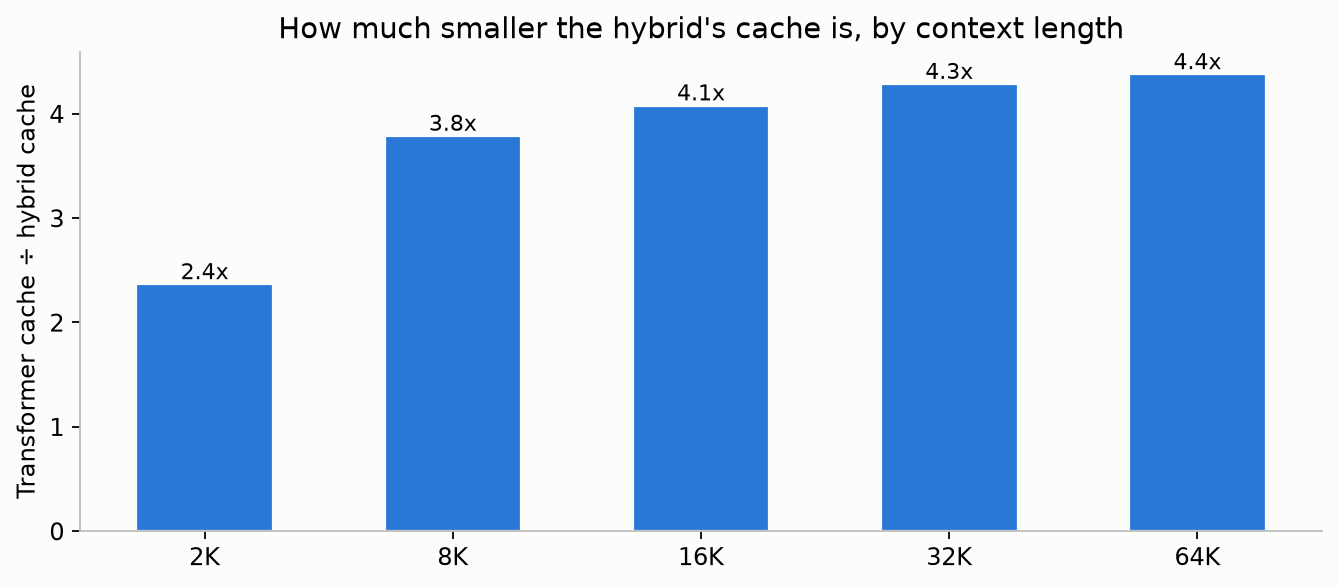
1. The Cache: 4.4x Smaller at 64K, Approaching 4.6x
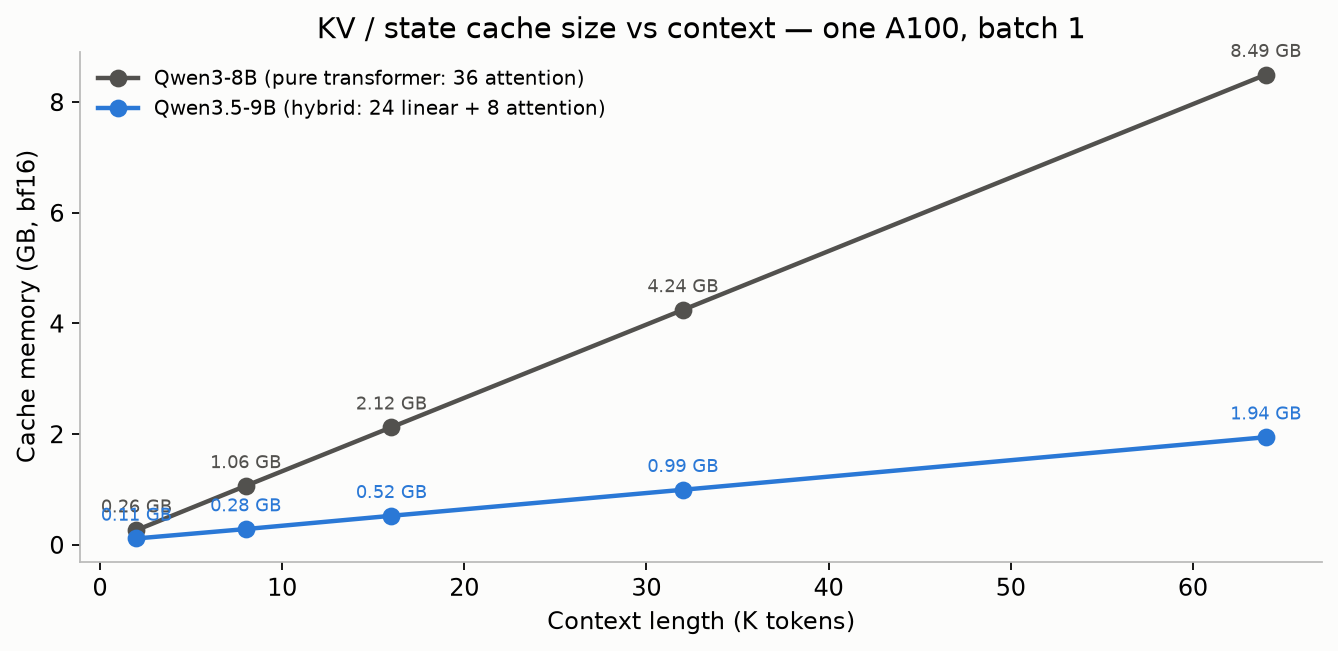
| Context | Qwen3-8B (transformer) | Qwen3.5-9B (hybrid) | ratio |
|---|---|---|---|
| 2K | 0.26 GB | 0.11 GB | 2.4x |
| 8K | 1.06 GB | 0.28 GB | 3.8x |
| 16K | 2.12 GB | 0.52 GB | 4.1x |
| 32K | 4.24 GB | 0.99 GB | 4.3x |
| 64K | 8.49 GB | 1.94 GB | 4.4x |
The numbers decompose exactly, which is the satisfying part.
Transformer: 36 layers × 8 KV heads × 128 head-dim × (K+V) × 2 bytes = 147 KB per token. 61,839 tokens → 8.49 GB. ✓
Hybrid: only the 8 attention layers grow with context. They use 4 KV heads × 256 head-dim × 2 × 2 bytes = 32 KB per token. The 24 Gated DeltaNet layers hold a *fixed-size* state regardless of context — a 32-head × 128 × 128 recurrent matrix plus a 4-wide convolution buffer per layer, about 25 MB total in bf16. So cache ≈ 25 MB + 32 KB × tokens. At 61,839 tokens: 1.94 GB. ✓
Two things follow. The asymptotic ratio is 147 / 32 = 4.6x, not the "4x" you'd get from the 8/32 layer count, because Qwen3.5 also uses fewer KV heads. And at short contexts the ratio is lower (2.4x at 2K) because the fixed linear state is a larger share — hybrids pay a small constant cost up front and win increasingly as context grows. The first post's "~25% of full KV cache" was, if anything, conservative.
For serving, this is the number that matters: at 64K context, one A100 holds roughly 30 concurrent Qwen3.5-9B sequences in the memory it takes to hold 7 Qwen3-8B sequences. That is the hybrid's actual product.
2. Speed: What We Measured, and Why It Doesn't Answer the Question
Here is the honest part. We also timed prefill and decode in HuggingFace eager mode:
| Context | Prefill tok/s (transformer) | Prefill tok/s (hybrid) | Decode tok/s (transformer) | Decode tok/s (hybrid) |
|---|---|---|---|---|
| 8K | 9,877 | 746 | 25.6 | 25.7 |
| 16K | 9,006 | 1,386 | 27.0 | 25.2 |
| 32K | 7,431 | 2,363 | 27.2 | 24.9 |
| 64K | 5,400 | 3,519 | 24.5 | 24.7 |
Read naively, the hybrid *loses* on prefill and ties on decode. That reading is wrong, and it is worth understanding exactly why, because it is the same trap anyone benchmarking a new architecture in a research framework falls into:
- Decode at ~25 tok/s for both is the Python loop, not the model. An A100 decodes an 8B model at 130–150 tok/s in llama.cpp or vLLM; HuggingFace eager decode is bound by per-step framework overhead, which is identical for both architectures. The measurement has no resolution left to see a KV-bandwidth difference.
- Hybrid prefill is kernel-bound in a way the transformer isn't. The transformer's attention runs on PyTorch's fused SDPA kernels, tuned for years. The Gated DeltaNet layers run on
flash-linear-attention's Triton kernels — and we could not buildcausal-conv1dagainst this machine's CUDA 12.1 toolchain, so the convolution falls back to a slow path. The first 2K-context run took 42 seconds, almost all of it Triton compilation. The hybrid's prefill throughput *doubles* from 8K to 64K (746 → 3,519 tok/s) while the transformer's *falls* (9,877 → 5,400), which is exactly the linear-vs-quadratic shape the theory predicts — but at 64K the hybrid is still at 65% of the transformer, because of kernel maturity, not architecture.
So: this experiment confirms the memory claim and cannot confirm or refute the speed claim. A fair speed comparison needs a serving engine with production kernels for both paths — vLLM added Qwen3.5 hybrid support (and even TurboQuant for its attention layers) this spring, and that is the follow-up we are running next.
A note on peak memory, since it surprised us: peak allocation during 64K prefill was *higher* for the hybrid (47.7 GB vs 41.7 GB). That is not the architecture either. Qwen3.5's vocabulary is 248K tokens versus Qwen3's 152K, and HuggingFace materializes logits for every position during prefill: 61,839 × 248,320 × 2 bytes ≈ 30 GB. A serving engine never does that.
3. What Changed From the First Post
| Claim in Part 1 | Measured |
|---|---|
| Hybrid KV cache ≈ 25% of full | 22% at 64K (4.4x), trending to 21.6% (4.6x) |
| ~2–3x inference speed | Not measurable in HF eager; deferred to a vLLM run |
| Fixed-size state for linear layers | Confirmed: ~25 MB regardless of context |
One correction to our own framing: the first post described the saving as coming from "75% linear layers." The larger lever in Qwen3.5-9B is that its 8 attention layers use 4 KV heads where Qwen3-8B uses 8. Half of the per-layer saving is GQA width, not the hybrid split. Architecture comparisons across model families always bundle several decisions; the cache arithmetic above is how to un-bundle them.
4. Reproduce
python -m venv ~/venvs/hybrid && ~/venvs/hybrid/bin/pip install torch==2.9.1 --index-url https://download.pytorch.org/whl/cu128
~/venvs/hybrid/bin/pip install "transformers>=5.9" flash-linear-attention
CUDA_VISIBLE_DEVICES=0 python bench-hybrid-hf.py --model Qwen/Qwen3-8B   --out hybrid-hf.json
CUDA_VISIBLE_DEVICES=0 python bench-hybrid-hf.py --model Qwen/Qwen3.5-9B --out hybrid-hf.json
The script (attached) sums numel × element_size over every tensor reachable from past_key_values, which is the only way to get an apples-to-apples cache size when one model's cache is a DynamicCache of K/V tensors and the other's carries recurrent states.
References
- Part 1: Hybrid Mamba-Transformer MoE — Three Teams, One Architecture
- Qwen3.5 model card and config (
layer_types,full_attention_interval) on Hugging Face - flash-linear-attention — Triton kernels for Gated DeltaNet
- vLLM PR #39931 — hybrid-model support used in the follow-up
Subscribe to Newsletter
Related Posts
TurboQuant From Scratch on Real KV Tensors — What 3 Bits Actually Cost, and Why the Forks Beat the Paper's Layout
PolarQuant in 60 lines of PyTorch on real KV from Llama-3.2-1B and Qwen3-8B: 3-bit costs +10% perplexity, k8v4 +0.2%, QJL only pays below 4 bits, and the block-32 layout explains half the forks' edge.
TurboQuant llama.cpp CUDA Fork, Measured on an A100 — turbo4 Matches q4_0, turbo3 Breaks at Long Context
Qwen3-8B Q4_K_M on one A100, six KV types: perplexity, prefill, decode-at-depth, and VRAM measured. turbo4 matches q4_0 quality and beats q8_0 decode 2.5x at depth; turbo3 triples perplexity at 32K context.
TurboQuant Status Check, August 2026 — What Actually Shipped in vLLM, llama.cpp, and Ollama
vLLM shipped it in v0.20 and published a sobering benchmark; llama.cpp upstream rejected it in June; Ollama's implementation is dead. We also correct our own earlier "merged in llama.cpp" claim — with links.