LLM Agent Cookbook: From ReAct to Multi-Agent in 4 Weeks
A 4-week curriculum for LLM Agent development using ReAct, LangGraph, and CrewAI.

LLM Agent Cookbook: From ReAct to Multi-Agent in 4 Weeks
Not sure where to start with LLM Agent development? You've heard of the ReAct pattern but don't know how to implement it? Curious about LangGraph and building multi-agent systems with CrewAI? This Cookbook has the answers.
Why LLM Agents?
LLMs like ChatGPT and Claude are powerful but have limitations:
- No access to real-time information
- Cannot interact with external systems
- Cannot execute complex multi-step tasks
Agents overcome these limitations. Give an LLM tools, and let it reason and act autonomously.
Curriculum Overview
Week 1: Foundations
- Understanding and implementing the ReAct pattern
- How Tool Calling works
- Designing robust schemas with Pydantic
Week 2: Enhanced Reasoning
- RAG and Memory systems
- Building complex workflows with LangGraph
- Improving retrieval quality with Self-RAG
Week 3: Multi-Agent Systems
- Building teams with CrewAI
- MCP and Agent-to-Agent communication
- Orchestration with Supervisor patterns
Week 4: Production Deployment
- Building safety with Guardrails
- Implementing Human-in-the-Loop
- Deploying with FastAPI + Docker
- Prompt optimization with DSPy
Key Features
- Hands-on Jupyter Notebook exercises
- Weekly real-world projects
- Solution code available on GitHub
- Bilingual support (Korean/English)
- Integration with DrillCheck AI interview practice
Who Is This For?
- Those with basic Python knowledge
- Anyone with LLM API experience
- Developers wanting to build their own agents
- Engineers looking to deploy agents in production
Get Started
Start building production-ready LLM Agents in just 4 weeks with this free Cookbook.
Subscribe to Newsletter
Related Posts
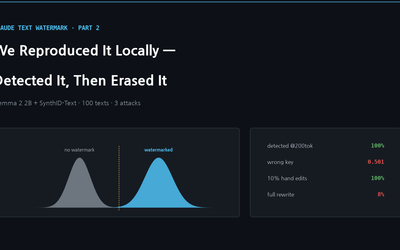
Reproducing Claude's Watermark Locally — SynthID-Text on an Open Model, With Detection and Removal Attacks
We applied SynthID-Text — the algorithm Claude adopted — to Gemma 2 2B and measured everything: why detection is impossible without the key, how many tokens it needs, why false positives explode on short text, and how one rewrite by a local 3B model erases the watermark.
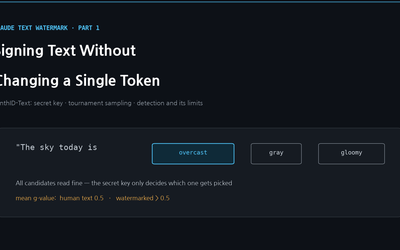
How Claude's Text Watermark Works — Signing Text Without Changing a Single Token
Every piece of text Claude generates now carries an invisible watermark — with nothing added to the text. A step-by-step walkthrough of SynthID-Text: the secret key, tournament sampling, detection, and the honest limits.
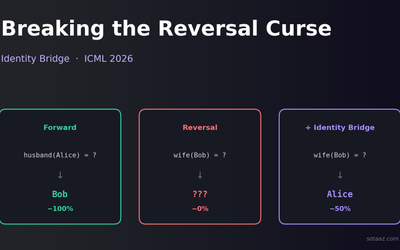
Breaking the Reversal Curse with Identity Bridges — the ICML 2026 fix that shouldn't work but does
LLMs trained on "Alice's husband is Bob" famously fail on "Bob's wife is?" — the reversal curse. A new ICML 2026 paper fixes it by adding one weird kind of self-referential example to the training set. The naive version doesn't work; the right version does.