30-Minute Behavioral QA Before Deploy: 12 Bugs That Actually Break Vibe-Coded Apps
Session, Authorization, Duplicate Requests, LLM Resilience — What Static Analysis Can't Catch
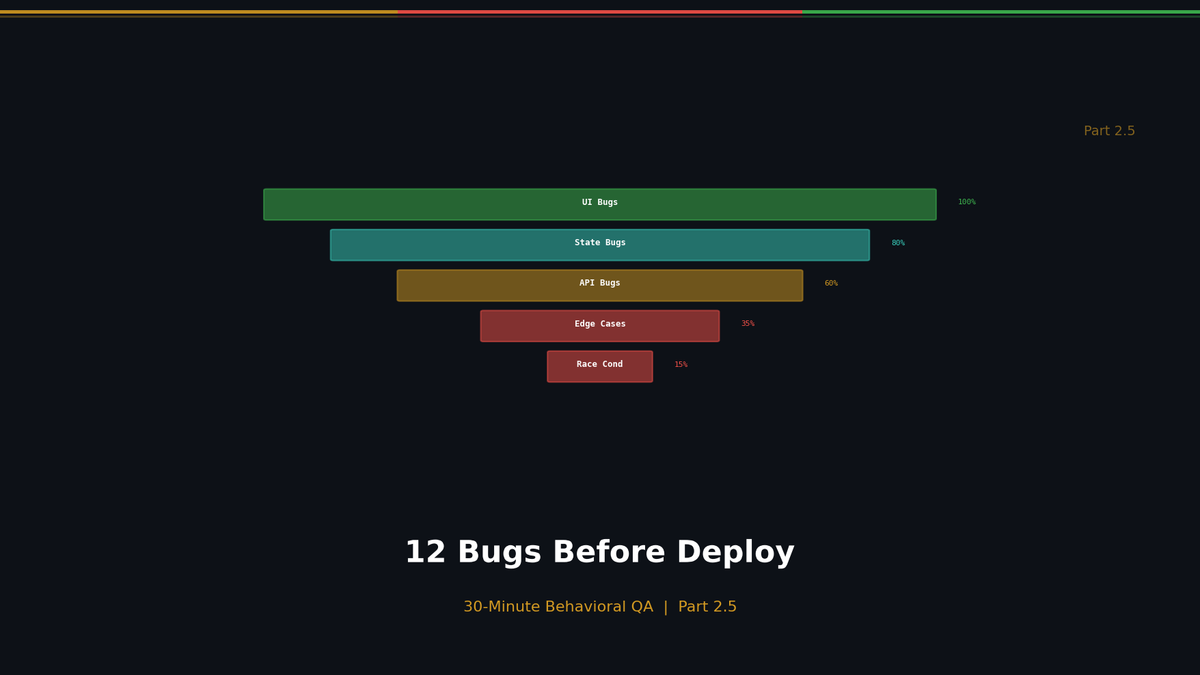
30-Minute Behavioral QA Before Deploy: 12 Bugs That Actually Break Vibe-Coded Apps
Session, Authorization, Duplicate Requests, LLM Resilience — What Static Analysis Can't Catch
TL;DR: Static analysis catches "code smells." Behavioral QA catches "actual breakage."
Prerequisites
This is NOT about hacking. This is a behavioral QA routine to reduce risk before deploying your own app in staging.
Related Posts
TurboQuant in vLLM on One A100 — Capacity, Speed, and Accuracy of All Four Presets on an 8B Model
vLLM 0.28, Qwen3-8B bf16, one A100 80GB: KV capacity, batched throughput, 32K decode, needle-in-haystack, and GSM8K for bf16, fp8, and all four TurboQuant presets — the 8B size vLLM's own study skipped.
TurboQuant From Scratch on Real KV Tensors — What 3 Bits Actually Cost, and Why the Forks Beat the Paper's Layout
PolarQuant in 60 lines of PyTorch on real KV from Llama-3.2-1B and Qwen3-8B: 3-bit costs +10% perplexity, k8v4 +0.2%, QJL only pays below 4 bits, and the block-32 layout explains half the forks' edge.
TurboQuant llama.cpp CUDA Fork, Measured on an A100 — turbo4 Matches q4_0, turbo3 Breaks at Long Context
Qwen3-8B Q4_K_M on one A100, six KV types: perplexity, prefill, decode-at-depth, and VRAM measured. turbo4 matches q4_0 quality and beats q8_0 decode 2.5x at depth; turbo3 triples perplexity at 32K context.