The Real Reason Launches Fail: Alignment, Accountability, Operations
AI Project Production Guide for Teams and Organizations
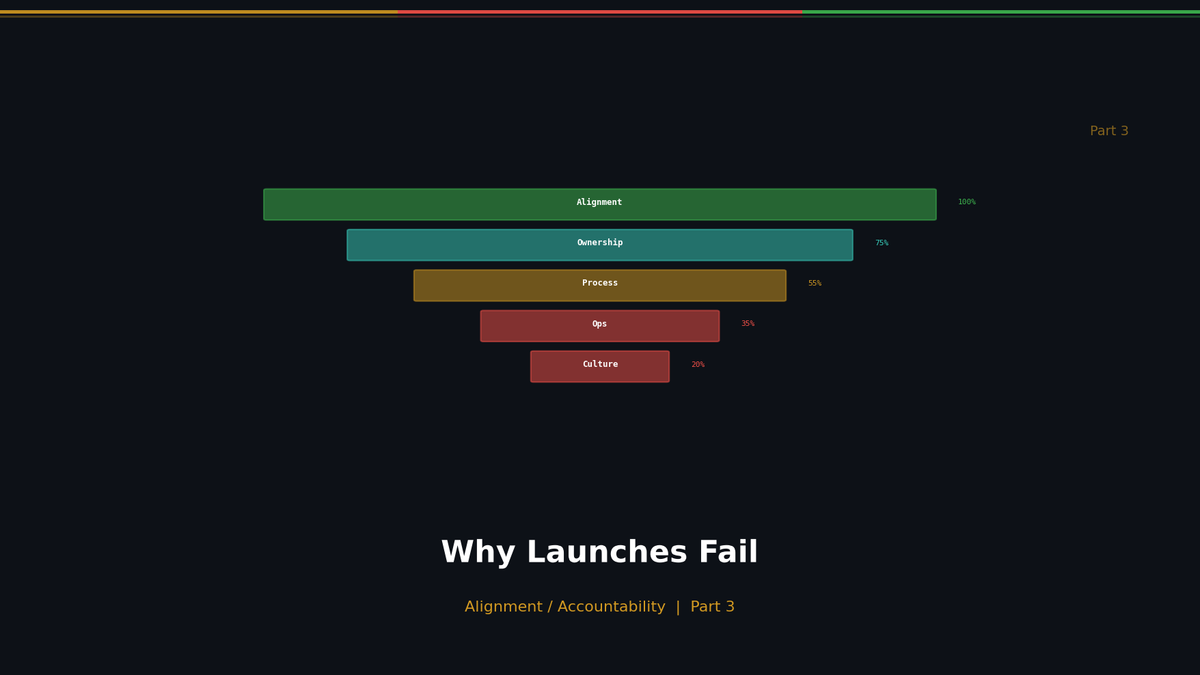
The Real Reason Launches Fail: Alignment, Accountability, Operations
AI Project Production Guide for Teams and Organizations
It's Not the Tech, It's the Organization
The code is perfect. Model performance is great. But the launch keeps getting delayed, or it quietly gets pulled within 3 months of launch.
Why? No alignment, unclear accountability, no operations framework.
Related Posts
TurboQuant From Scratch on Real KV Tensors — What 3 Bits Actually Cost, and Why the Forks Beat the Paper's Layout
PolarQuant in 60 lines of PyTorch on real KV from Llama-3.2-1B and Qwen3-8B: 3-bit costs +10% perplexity, k8v4 +0.2%, QJL only pays below 4 bits, and the block-32 layout explains half the forks' edge.
TurboQuant llama.cpp CUDA Fork, Measured on an A100 — turbo4 Matches q4_0, turbo3 Breaks at Long Context
Qwen3-8B Q4_K_M on one A100, six KV types: perplexity, prefill, decode-at-depth, and VRAM measured. turbo4 matches q4_0 quality and beats q8_0 decode 2.5x at depth; turbo3 triples perplexity at 32K context.
TurboQuant Status Check, August 2026 — What Actually Shipped in vLLM, llama.cpp, and Ollama
vLLM shipped it in v0.20 and published a sobering benchmark; llama.cpp upstream rejected it in June; Ollama's implementation is dead. We also correct our own earlier "merged in llama.cpp" claim — with links.