Production Survival Guide for Vibe Coders
5 Non-Negotiable Standards for Enterprise Deployment
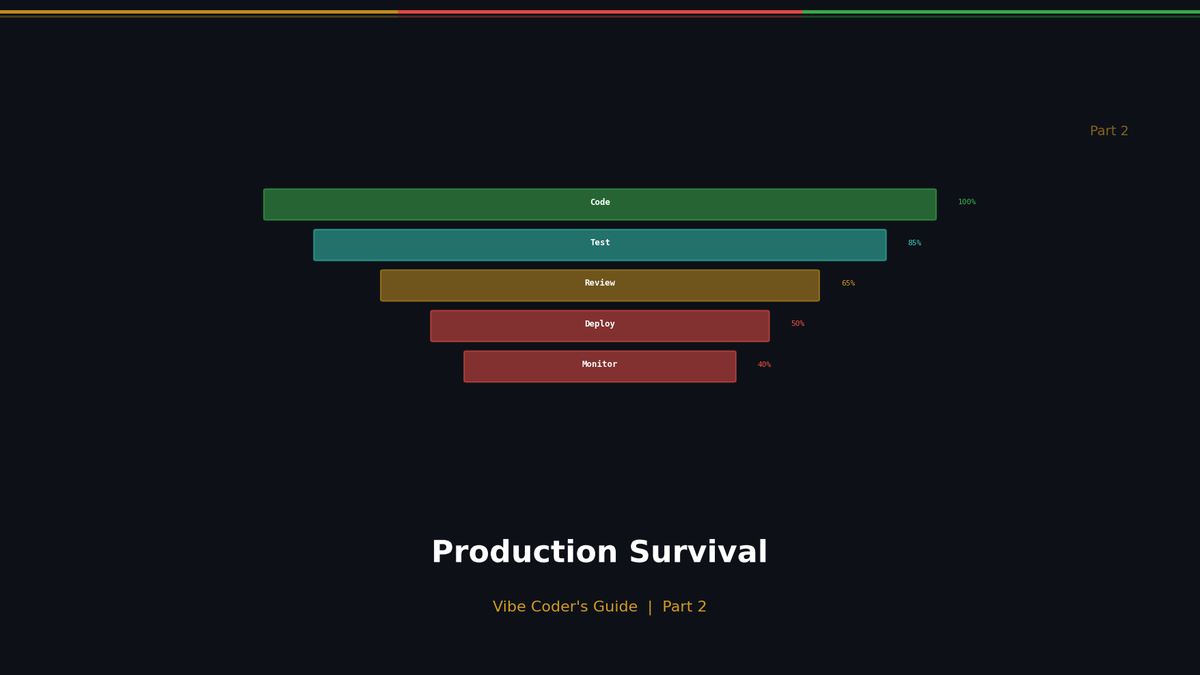
Production Survival Guide for Vibe Coders
5 Non-Negotiable Standards for Enterprise Deployment
In the age of vibe coding, anyone can deploy an app. But preventing post-launch disasters isn't about coding skills—it's about engineering standards.
Just clicking the Vercel deploy button? Here are the 5 safety measures that enterprises never skip before launching a service.
Step 1: Visibility (Logging & Monitoring)
Related Posts
TurboQuant From Scratch on Real KV Tensors — What 3 Bits Actually Cost, and Why the Forks Beat the Paper's Layout
PolarQuant in 60 lines of PyTorch on real KV from Llama-3.2-1B and Qwen3-8B: 3-bit costs +10% perplexity, k8v4 +0.2%, QJL only pays below 4 bits, and the block-32 layout explains half the forks' edge.
TurboQuant llama.cpp CUDA Fork, Measured on an A100 — turbo4 Matches q4_0, turbo3 Breaks at Long Context
Qwen3-8B Q4_K_M on one A100, six KV types: perplexity, prefill, decode-at-depth, and VRAM measured. turbo4 matches q4_0 quality and beats q8_0 decode 2.5x at depth; turbo3 triples perplexity at 32K context.
TurboQuant Status Check, August 2026 — What Actually Shipped in vLLM, llama.cpp, and Ollama
vLLM shipped it in v0.20 and published a sobering benchmark; llama.cpp upstream rejected it in June; Ollama's implementation is dead. We also correct our own earlier "merged in llama.cpp" claim — with links.