5 Reasons Your Demo Works But Production Crashes
Common patterns across AI, RAG, and ML projects — why does "it worked fine" fall apart in production?
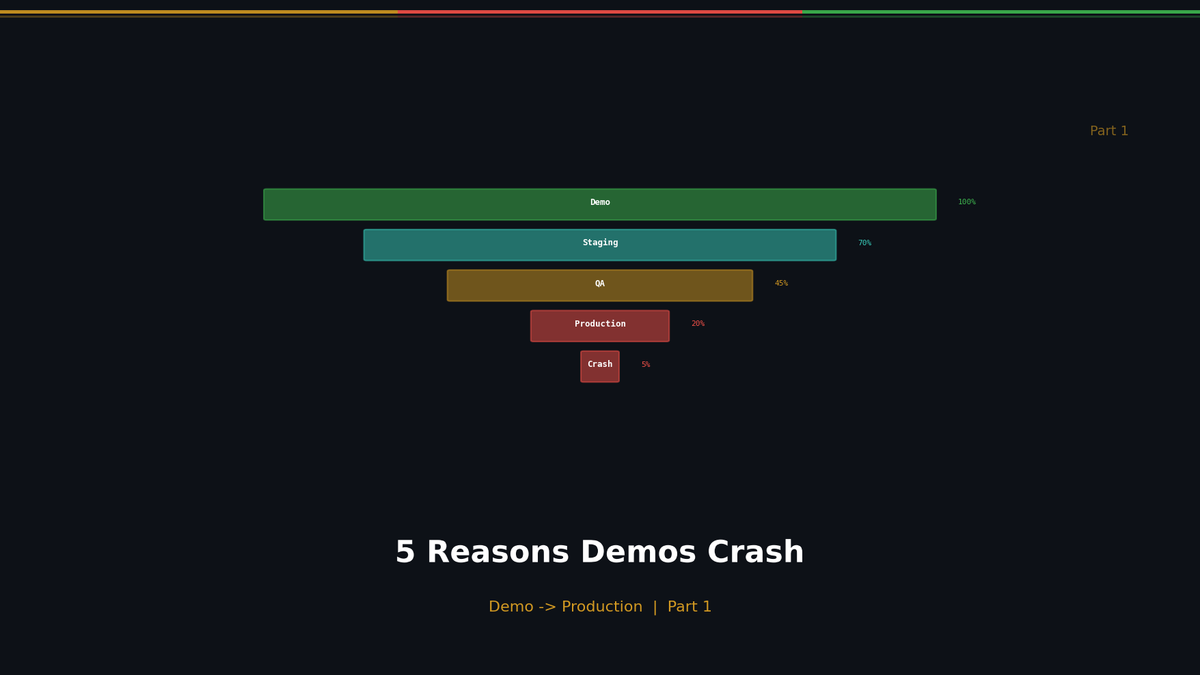
5 Reasons Your Demo Works But Production Crashes
Common patterns across AI, RAG, and ML projects — why does "it worked fine" fall apart in production?
Demo vs Launch
Demo: Good inputs + single run + someone watching
Launch: Bad inputs + repetition + edge cases + operations + accountability
Fail to recognize this difference, and your demo that got applause will be rolled back within a week of launch.
1. Input Distribution Shifts
Demo set vs Reality
During demos, you pick examples that work well. In reality, you get typos, abbreviations, weird formats, and adversarial inputs.
Symptoms: Dramatic failures on specific cases. "90% average accuracy, so why are complaints flooding in?"
Remedies:
- Shadow traffic to understand real input distribution
- Canary deployment to expose only partial traffic first
- Automated failure case collection loop
2. Dependencies Multiply
Tools / Search / External APIs / Permissions / Network
In demos, all external services work perfectly. In production, APIs slow down, tokens expire, networks drop.
Symptoms: Retry storms, timeouts, partial failures. "It worked yesterday, why is it broken today?"
Remedies:
- Time budget (cap on total request time)
- Circuit breaker to prevent failure propagation
- Graceful degradation (fallback paths when externals fail)
3. Evaluation Criteria Change
Accuracy → Trust / Accountability / Explainability
In demos, "correct = success". In production, "correct can still be problematic" and "wrong = major incident".
Symptoms: Accurate answers generating complaints. Legal team reaches out. "Who's responsible for this?"
Remedies:
- Policies/guardrails (sensitive topics, PII)
- Abstain option (refuse to answer when uncertain)
- Evidence-first (show sources before conclusions)
4. State/Cache/Concurrency Enter the Picture
Production means repetition
Demos run once and done. In production, the same question comes 1000 times, gets cached, and is processed concurrently.
Symptoms: Same question, different answers. Cache pollution. Race conditions.
Remedies:
- Deterministic path (temperature=0, fixed seed)
- Clear caching policy (when to cache, when to regenerate)
- Idempotency guarantee (same request = same result)
5. Operations Begin
Monitoring / Alerts / Rollback / Hotfix
Demos have no operations. In production, alerts fire at 3 AM, and you discover something's been silently broken for a week.
Symptoms: Silent failures (wrong results, no error logs). Cost explosions (infinite retries).
Remedies:
- Define SLO/SLI (success rate, latency, cost caps)
- Set error budget (acceptable failure rate)
- Design logging (track 0-hit, retry, fallback)
Pre-Launch Checklist
| Item | Check |
|---|---|
| Do you have test data similar to real traffic? | ☐ |
| Is there a fallback when external dependencies fail? | ☐ |
| Are abstain conditions defined? | ☐ |
| Are sensitive topic guardrails in place? | ☐ |
| Is caching policy clear? | ☐ |
| Does same input produce same output? | ☐ |
| Are error logs being collected? | ☐ |
| Is there a cost cap? | ☐ |
| Is there a rollback procedure? | ☐ |
| Is there a designated person to contact during incidents? | ☐ |
If 3 or more items are ☐, you're not ready to launch.
Next in Series
- Part 2: For Vibe Coders — "Why does it break when I deploy what worked locally?"
- Part 3: For Teams/Organizations — "The real reason launches fail: Alignment, Accountability, Operations"
Subscribe to Newsletter
Related Posts
TurboQuant From Scratch on Real KV Tensors — What 3 Bits Actually Cost, and Why the Forks Beat the Paper's Layout
PolarQuant in 60 lines of PyTorch on real KV from Llama-3.2-1B and Qwen3-8B: 3-bit costs +10% perplexity, k8v4 +0.2%, QJL only pays below 4 bits, and the block-32 layout explains half the forks' edge.
TurboQuant llama.cpp CUDA Fork, Measured on an A100 — turbo4 Matches q4_0, turbo3 Breaks at Long Context
Qwen3-8B Q4_K_M on one A100, six KV types: perplexity, prefill, decode-at-depth, and VRAM measured. turbo4 matches q4_0 quality and beats q8_0 decode 2.5x at depth; turbo3 triples perplexity at 32K context.
TurboQuant Status Check, August 2026 — What Actually Shipped in vLLM, llama.cpp, and Ollama
vLLM shipped it in v0.20 and published a sobering benchmark; llama.cpp upstream rejected it in June; Ollama's implementation is dead. We also correct our own earlier "merged in llama.cpp" claim — with links.